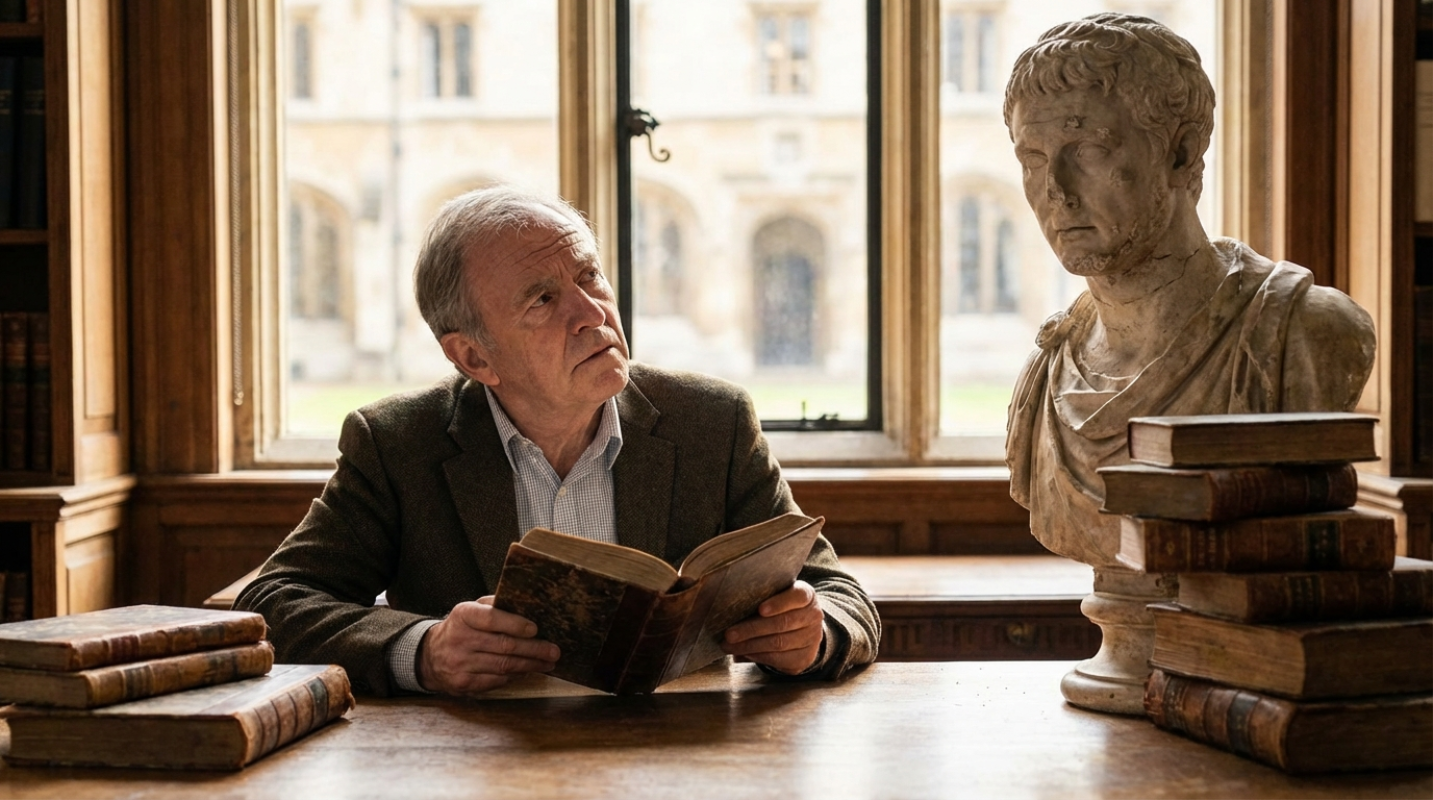
Think about your day so far. You probably assumed the floor wouldn’t vanish when you stepped on it, or that the coffee you brewed contained actual coffee. We operate daily under a comforting blanket of assumed certainty—a set of foundational beliefs we rarely question.
But for centuries, a certain type of philosopher has found that certainty deeply suspicious.
The branch of philosophy concerned with how we know things is called epistemology. For much of history, thinkers sought foundationalism: a bedrock, undeniable truth upon which all other knowledge could be safely stacked. The five thinkers we’re about to meet didn’t just question the layers of knowledge; they attacked the bedrock itself. They deliberately dismantled the foundations of certainty, not to destroy knowledge, but to force us to build something deeper, stronger, and more honest.
Descartes and the Method of Doubt
René Descartes, writing in the 17th century, decided he needed to doubt everything he had ever been taught. His quest was simple: find one single, undeniable truth.
How do you test reality? Descartes introduced radical doubt, famously culminating in the thought experiment of the Evil Demon. Imagine a being of supreme power and cunning dedicated entirely to deceiving you. Every sensory input, every memory, every logical deduction—all could be lies spun by this malicious entity.
You might think this sounds like an ancient fable, but today, we recognize the Evil Demon as an early version of the Simulation Hypothesis. If you’ve watched a movie like The Matrix, you understand the core philosophical premise. The modern rise of immersive Virtual Reality and increasingly sophisticated AI makes Descartes’ challenge terrifyingly relevant in 2026: How do we know the world we perceive isn't just a meticulously created digital lie?
The beauty of Descartes’ method is that it forces a retreat to the absolute core. Even if the Demon deceives you about your body, the sky, and mathematics, one thing remains certain: there must be a you doing the doubting. This leads to his famous conclusion, “Cogito, ergo sum” (I think, therefore I am). The existence of the thinking self is the only truly indubitable foundation.
Hume's Assault on Causality and Induction
If Descartes set the stage for modern skepticism, David Hume, the great 18th-century Scottish empiricist, delivered the devastating punchline. Hume agreed that knowledge must come from experience, but he then revealed a massive flaw in how we interpret that experience: the Problem of Induction.
Induction is the process of generalizing from past observations to future predictions. Every time you’ve seen the sun, it has risen. Therefore, you assume it will rise tomorrow. Hume asked: Where is the logical justification for that assumption? There isn’t one.
Hume argued that our belief in causality—that A necessarily causes B—is nothing more than a psychological habit, or “custom.” We see A followed by B repeatedly, and our minds, out of convenience, create a necessary connection. But past regularity does not logically guarantee future results.
This isn't just a parlor game; Hume’s challenge fundamentally undermines empirical science. Modern thinkers, like Karl Popper, have responded by suggesting that science shouldn't seek to justify knowledge (which Hume proved impossible) but rather focus on making testable, "risky predictions" that can be falsified. The pragmatic, real-world stakes of this philosophical problem were evident in the patterns of reasoning used by organizations like the WHO when dealing with unprecedented events like the COVID-19 pandemic.
Kant's Copernican Revolution in Epistemology
Immanuel Kant, roused from his “dogmatic slumber” by Hume, realized that if Hume was right, science was doomed. Kant’s solution was radical: instead of the mind conforming to the world (as we usually assume), the world must conform to the mind. This was his "Copernican Revolution" in philosophy.
Kant argued that we never access the world as it truly is (the noumenon). Instead, we only know the world as it appears to us (the phenomenon). Why? Because our minds possess innate, a priori structures—like space, time, and causality—that filter and organize sensory experience. These aren't things we observe; they are the mental sunglasses through which we must look.
So what does this mean? It means science, which relies on observing objects in space and time, is perfectly valid, but it can only ever study appearances. Science can never penetrate the true, independent nature of reality. This conclusion places a permanent, uncrossable limit on human knowledge, fundamentally challenging the faith in science to provide ultimate, absolute answers and strongly influencing modern agnostic thought.
Nietzsche and the Subjectivity of Truth
By the 19th century, Friedrich Nietzsche took the skepticism of his predecessors and applied it to the entire Enlightenment project. Nietzsche didn't just question how we know things; he questioned why we even strive for objective truth.
For Nietzsche, there is no single, objective truth; there are only interpretations—a concept known as perspectivism. Knowledge, language, and morality are all constructs driven by the human "will to power"—the basic drive to grow, expand, and impose meaning on chaos.
He famously stated that "truths are illusions we have forgotten are illusions." What we call "facts" are simply durable, useful metaphors that have become hardened by time and widespread acceptance.
This radical view is often accused of leading to epistemic nihilism, where all beliefs are equally valid. But contemporary analysis suggests Nietzsche wasn't a simple relativist. He recognized that some perspectives are more coherent and, importantly, more "life-affirming" than others, allowing us to build successful, functioning cultures.⁴ His work is foundational to much of postmodern thought, shaping how we view science, power, and history today.