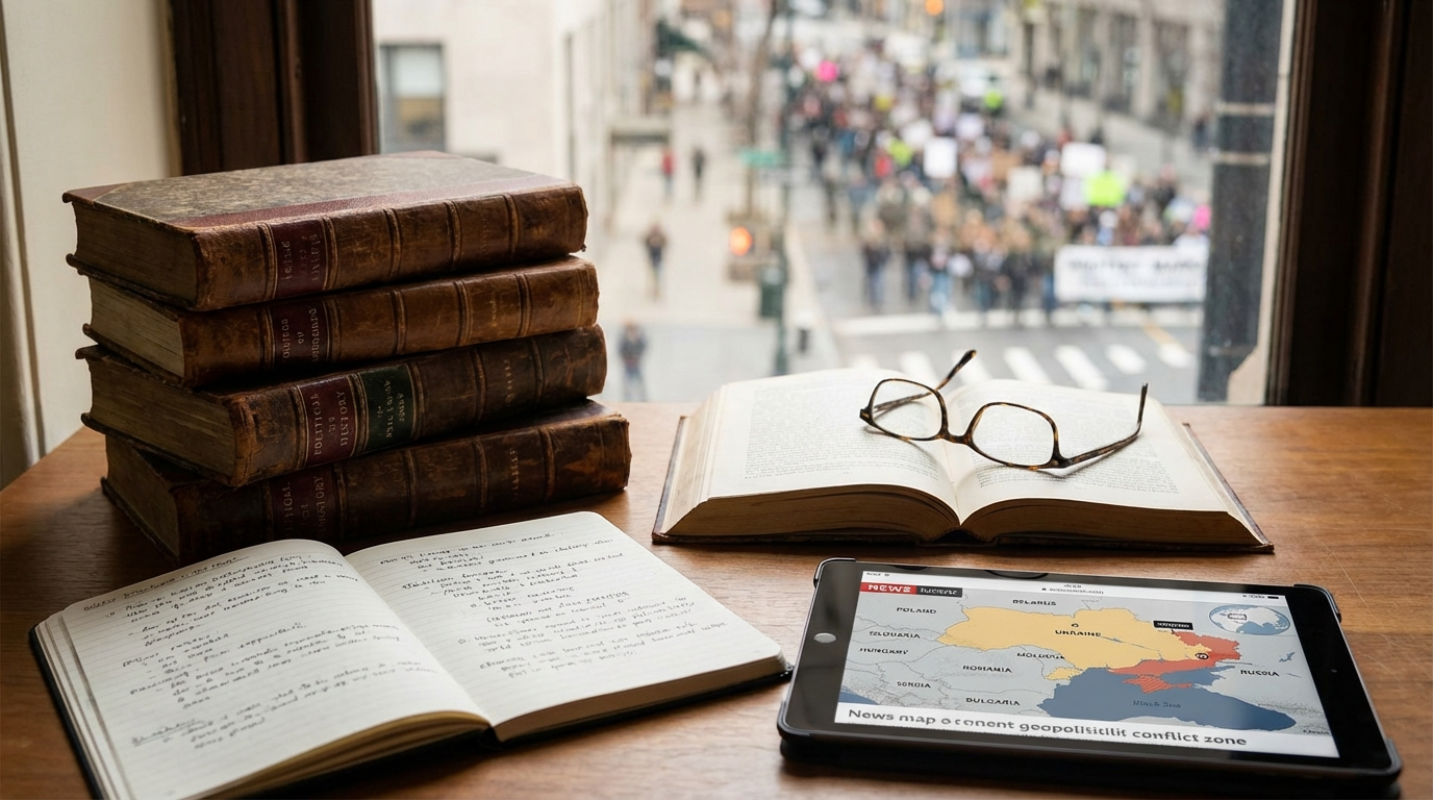
Trying to understand global conflicts from news headlines alone can feel like walking into a movie halfway through. You see the action, but you miss the plot, the character development, and the reasons why everything is happening. To truly grasp the world we live in, we need to go deeper. Books are one of the best ways to get the full story, providing the context, history, and human perspectives that headlines leave out.
If you’re looking to build a more complete picture of global politics, we’ve got you covered. Here is a curated list of books that offer valuable insights into the complex dynamics of international conflicts. Each one provides a unique lens, helping you connect the dots and understand the world on a deeper level.
The Looming Tower: Al-Qaeda and the Road to 9/11 by Lawrence Wright
To understand many of the conflicts of the 21st century, it’s essential to understand the events that led to September 11, 2001. Lawrence Wright’s Pulitzer Prize-winning book is a masterclass in investigative journalism. It traces the origins of Al-Qaeda, not as a monolithic entity, but as the product of intersecting lives, ideologies, and historical moments.
Why it's a must-read: Wright combines deep research with compelling storytelling, creating a narrative that reads like a thriller. By focusing on the people involved—from Osama bin Laden to the FBI agents on his trail—the book provides a human-scale understanding of the forces that shaped a generation of global policy.
A Problem from Hell: America and the Age of Genocide by Samantha Power
Why do genocides happen, and why does the international community so often fail to stop them? Samantha Power, a former U.S. Ambassador to the United Nations, tackles this harrowing question with unflinching clarity. The book examines several major genocides of the 20th century, including the Armenian genocide, the Holocaust, Cambodia, and Rwanda, and critiques the persistent inaction of American and global leaders.
Why it's a must-read: This book is both a historical account and a powerful call to action. It challenges readers to confront uncomfortable truths about political will and moral responsibility. It's an essential read for anyone interested in human rights, international law, and the difficult choices leaders face during humanitarian crises.
Nothing to Envy: Ordinary Lives in North Korea by Barbara Demick
Global politics aren't just about leaders and treaties; they're about the everyday people whose lives are shaped by them. Barbara Demick offers a rare and intimate look into one of the world's most secretive nations through the stories of six North Korean defectors. She chronicles their lives over fifteen years, capturing their initial faith in the regime, their slow disillusionment, and their eventual escape.
Why it's a must-read: Demick turns a political abstraction—the North Korean regime—into a tangible, human story. You'll learn about the country not through statistics, but through the personal experiences of love, loss, and survival. It’s a powerful reminder that behind every political conflict are ordinary people navigating extraordinary circumstances.
Prisoners of Geography: Ten Maps That Explain Everything About the World by Tim Marshall
Sometimes, the simplest way to understand a conflict is to look at a map. Journalist Tim Marshall argues that geography—mountains, rivers, seas, and climate—has always been a primary driver of world history and politics. He uses ten maps, from Russia to Africa to the Middle East, to explain how physical landscapes have shaped the destinies of nations and fueled many of their conflicts.
Why it's a must-read: Marshall makes complex geopolitical concepts accessible and engaging. This book provides a foundational framework for understanding why certain regions are perennial hotspots and why leaders make the decisions they do. It’s a fantastic starting point for anyone looking to build a broad understanding of international relations.