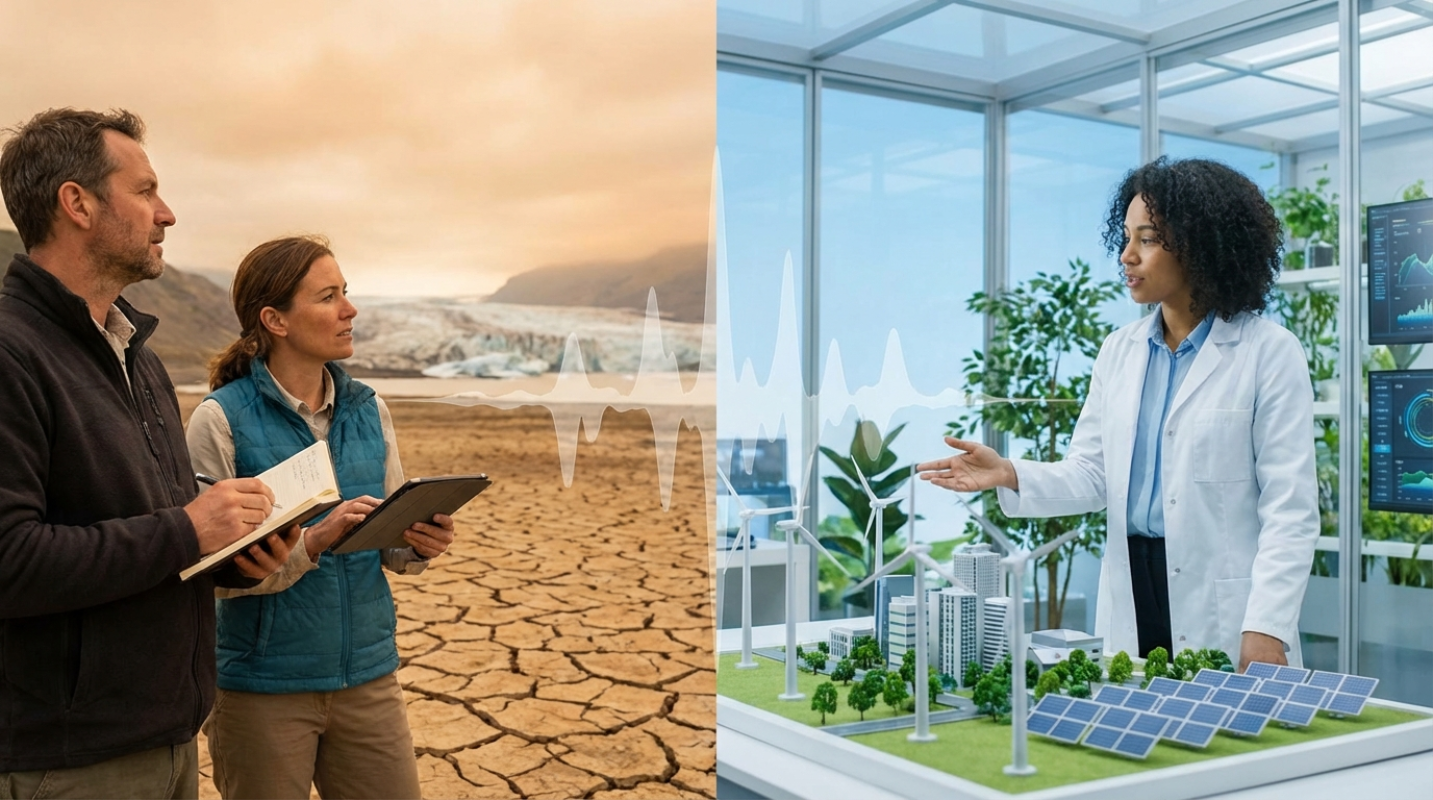
The fundamental science of climate change is settled. The planet is warming, and humanity is the cause. We passed the point of arguing about the reality of anthropogenic warming years ago. But if you’re following the science today—not the political noise, but the actual journals and IPCC follow-up reports—you know the conversation has moved on. The focus isn't if it’s happening, but how fast, how severe, and what terrifying things we might accidentally trigger along the way.
These are the scientific debates that actually matter for policy in 2026, because the range of possibilities—from "bad but manageable" to "catastrophic and irreversible"—depends entirely on the answers. Understanding these active disagreements isn't about feeding denial; it's about designing smart, decisive action. If you don't know the difference between Equilibrium Climate Sensitivity (ECS) and a Tipping Cascade, you can’t fully grasp the urgency facing global leaders right now.
The Climate Sensitivity Question: How Hot Will It Really Get?
The most important number we still don't know precisely is the Earth’s Climate Sensitivity. Think of it as the planet’s fever response. If we double the concentration of atmospheric carbon dioxide (CO2), how many degrees Celsius hotter does the planet get?
Scientists use two main metrics. The Equilibrium Climate Sensitivity (ECS) describes the warming after the climate system has fully adjusted (which takes centuries). The Transient Climate Response (TCR) describes the warming we’d see around the time CO2 actually doubles, which is the figure most relevant to our children and grandchildren.
The IPCC’s best estimate for ECS is around 3°C, but the range is wide—and that range holds the key to our future.
Why the uncertainty? Clouds. Cloud feedback mechanisms are the primary drivers of disagreement among climate models. Are clouds primarily reflective (cooling the planet) or insulating (warming it)? The answer dramatically changes the ECS.
This debate took on a sudden, terrifying urgency in 2024. Global temperatures spiked far higher than expected, baffling many scientists. The 12-month average peaked in August 2024 at an alarming +1.6°C relative to the pre-industrial average. One major hypothesis for this sudden jump points directly back to a 2020 international restriction on ship aerosol emissions. By cleaning up the sulfur that reflected sunlight and seeded cooling clouds, we may have inadvertently exposed just how sensitive the climate system really is.
If the climate system is indeed more sensitive than the IPCC’s most probable estimate, it means those models that predict a "particularly hot future" (roughly one-third of the models evaluated in recent studies) are actually plausible. And if those models are right, our current carbon budgets are dangerously optimistic.
Tipping Points and Feedback Loops: Are We Closer Than We Think?
Although climate sensitivity tells us how hot things get, tipping points tell us when the system fundamentally breaks. A tipping point is a important threshold beyond which a system reorganizes, often abruptly and irreversibly. It’s not a gradual slope; it’s a cliff.
The Global Tipping Points Report, released at COP28, identified over 25 potential tipping points, and the scientific focus has shifted from "if" they exist to "how close" we are to triggering them.
Consider the Atlantic Meridional Overturning Circulation (AMOC), the conveyor belt of ocean currents that regulates climate across the Northern Hemisphere. If the AMOC collapses due to freshwater melt from Greenland, it could radically alter weather patterns globally. Or look at the melting of the Greenland and West Antarctic ice sheets, which, if tipped, could lock in 10 meters of long-term sea-level rise. That’s an existential threat to coastal cities.
The debate here isn't just about individual systems; it’s about Tipping Cascades. Tipping one system—say, melting permafrost releasing massive amounts of methane—makes tipping another, like the Amazon dieback, far more likely.
We aren't just speculating about these risks; many systems are already showing severe stress. At current heating levels, like, 99% of warm-water coral reefs are experiencing heatwaves too frequent for them to recover. They have effectively crossed their thermal tipping point.
Some experts, but caution against the term "tipping point," arguing it’s overused and misleading, suggesting we shouldn't hunt for a single, unfixable moment. They prefer focusing on a "constellation of warning signs." But whatever terminology you use, the message from the Dartington Declaration is stark: we have entered a "danger zone," and minimizing the duration of any temperature overshoot above 1.5°C is paramount.
Geoengineering: A Risky Savior or Necessary Backstop?
As the climate crisis accelerates, the debate over deliberately intervening in the Earth’s systems—geoengineering—has moved from the fringe to the forefront of scientific discussion. This is perhaps the most ethically fraught debate of all.
We generally divide geoengineering into two categories:
- Carbon Dioxide Removal (CDR): Techniques that suck CO2 directly out of the atmosphere (like Direct Air Capture and Storage, or DACCS). This is slow, expensive, but generally considered needed.
- Solar Radiation Management (SRM): Techniques that reflect a small fraction of sunlight back into space, such as injecting aerosols into the stratosphere. This is fast, cheap, and terrifying.
The scientific community is deeply divided on SRM. Proponents see it as a necessary backstop—a way to rapidly cool the planet if tipping points loom. Critics point to the immense unknown risks: regional weather shifts, potential ozone depletion, and, perhaps most importantly, the governance vacuum.
Who decides when to start spraying? Who controls the planetary thermostat? If one nation decides to dim the sun and another suffers a severe drought as a result, what happens?
The current state of global governance for geoengineering is piecemeal and lacking. This was starkly demonstrated in 2024 when Harvard University shuttered the SCoPEx project, which would have been the first outdoor stratospheric aerosol injection experiment, due to a lot of opposition rooted in ethical and governance concerns.
The consensus now is that while CDR research must be scaled rapidly, SRM research must be governed before it starts. The ethical debate centers on equity: respondents in the Global South, who are most vulnerable to climate impacts, express the richest range of concerns over global inequities and possible geopolitical conflict resulting from such interventions. We need an ethical framework, not a free-for-all.
Sustainability Metrics: Moving Beyond GDP and Carbon Budgets
Sustainability isn't just about physics; it's about economics and resource management. If we truly want to hit net-zero targets, we have to address the underlying engine of consumption, and that means challenging the metrics we use to measure success.
The current debate focuses on the tension between Green Growth and Degrowth.
- Green Growth proponents argue that technological innovation, efficiency gains, and circular economy models can decouple economic growth (GDP) from environmental impact. We can have our cake and eat it too, provided the cake is solar-powered and locally sourced.
- Degrowth proponents, backed by resource science, argue that absolute decoupling is impossible at the required scale and speed. They suggest that wealthy nations must deliberately reduce throughput and consumption to stay within planetary boundaries.
This isn’t just an academic squabble. The scientific reality is that global emissions would need to fall by 7.5% per year through 2035 to return to a 1.5°C pathway. That requires systemic change that goes far beyond swapping out lightbulbs.
The science of 2026 increasingly validates the need for deep systemic changes. We need new metrics that prioritize ecological health and social equity over simple GDP gains. The IPCC’s shift in focus for the upcoming AR7 cycle, heavily emphasizing adaptation and systemic vulnerability, reinforces this. The science suggests that fragmentation and small-scale solutions won't cut it. We must transition to true circular economy models where waste is eliminated, and resources are kept in use—a massive scientific and engineering challenge in itself.
Top Recommendations for Adaptive Policy
- Invest in High-End Climate Modeling: Prioritize funding for climate models that incorporate high sensitivity estimates. Policy must plan for the worst-case scenario (high ECS) as a plausible outcome, not just a fringe possibility.
- Mandate Geoengineering Governance: Establish an international, multidisciplinary body (perhaps under the UN) to control and oversee all research into Solar Radiation Management (SRM) before any further field tests are authorized.
- Shift from Planning to Implementation: Focus adaptation funding on large-scale, integrated projects (e.g., managed retreat, resilient infrastructure) rather than fragmented planning studies, recognizing that 3.6 billion people already live in highly susceptible areas.
- Adopt Resource-Based Metrics: Supplement GDP reporting with complete resource depletion and ecological health metrics to track true sustainability progress, moving beyond simple carbon accounting.