 (Image source: Gemini)
 If you were in Paris in the summer of 2024, you weren’t imagining things: the city was absolutely saturated. The promise of the Summer Games was always about spectacle and profit, and Paris delivered on both—but the tourism boom that followed was far more complex than just high booking numbers. It was a perfect storm of economic uplift for some, logistical chaos for many others, and a massive stress test for one of the world’s most visited destinations.
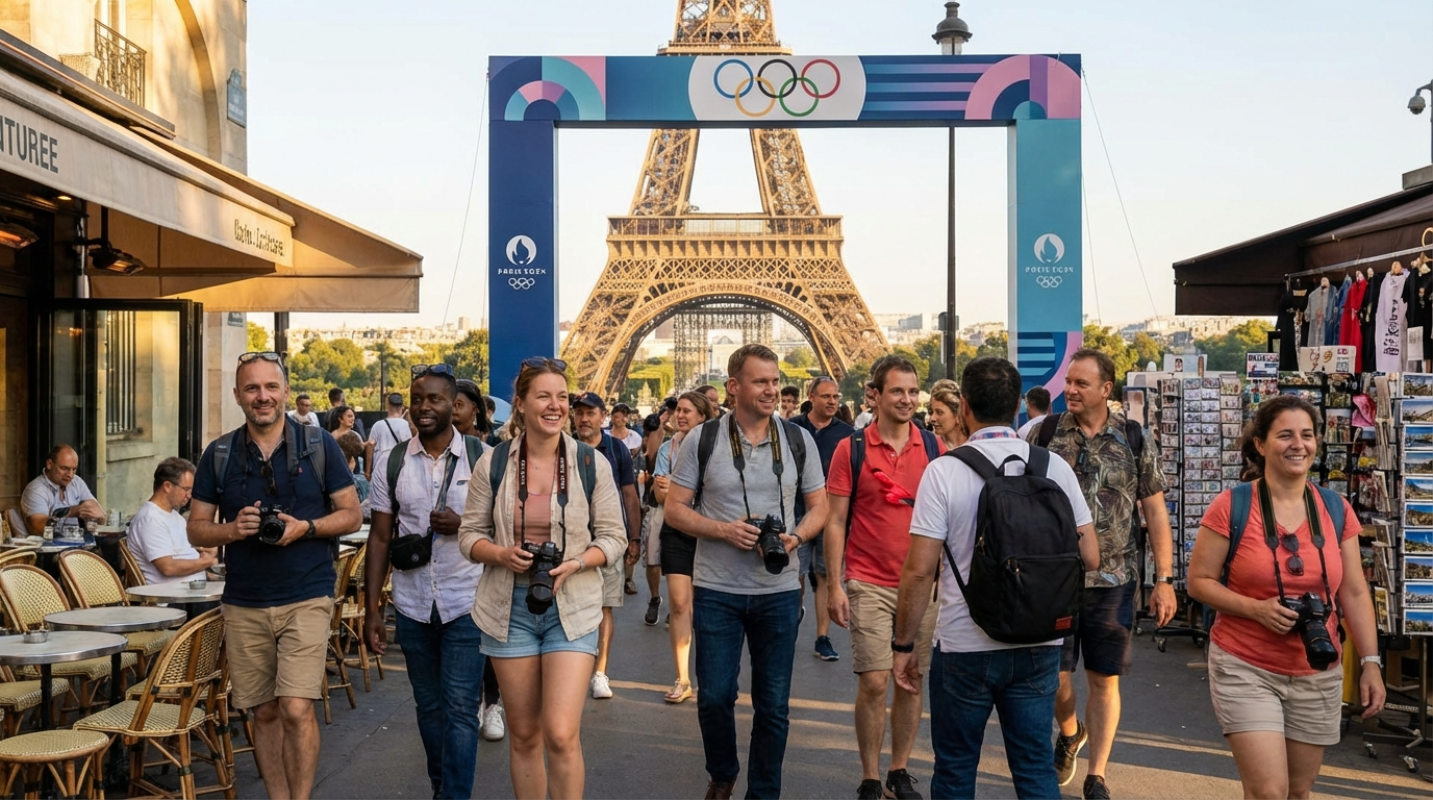
The scale of the event was staggering. The Greater Paris region welcomed an estimated 11.2 million visitors during the Olympic period.⁸ That’s a tidal wave of humanity, all needing beds, transit, and croissants. The thesis here is simple: while the Games generated billions in revenue and set new records for international arrivals, that success came with serious trade-offs, creating a mixed financial picture where high-end hospitality thrived, but local, non-Olympic businesses often suffered.
Economic Forecasting: Quantifying the Tourism Revenue Surge
The initial economic projections for Paris 2024 were, predictably, enormous. Before the Games, analysts were throwing around figures suggesting the total economic impact—including construction, organization, and tourism—could hit €10.7 billion.¹ Focusing just on tourism, the predicted revenue surge was estimated to be between €2 billion and €4 billion, driven largely by the estimated €2.6 billion in spending by tourists traveling to Paris during the Games.¹
So what does this actually mean in practice? It means that the hospitality sector hit the jackpot.
The Accommodation Gold Rush
The most immediate and obvious beneficiaries were lodging providers. If you tried to book a hotel or a short-term rental during the Olympic fortnight, you know exactly what happened. Online Travel Agency rates more than doubled, and reports showed that short-term rental hosts increased prices by a factor of three. did rent skyrocket, but the local tourist tax also increased by nearly 200% for luxury accommodation.
This wasn't just a boom; it was a gold rush, and the city itself benefited immediately from the increased taxes.
The Crowding Out Effect
Here’s the key insight that often gets missed when we talk about Olympic profitability: massive events create a "crowding out" effect. The high prices, stringent security zones, and general disruption deterred the typical, non-Olympic traveler—the casual tourist who might have been visiting the Louvre in August.
This created a strange paradox. Although Paris welcomed 3.1 million tourist arrivals during the Olympic fortnight (a great number), the increase was heavily skewed toward ticket-holders and French visitors. Foreign arrivals saw a respectable 13% bump, but many traditional cultural sites saw their usual summer crowds vanish.
Consider these figures: cultural institutions like the Louvre saw a 14% decrease in visitors, the Musée d'Orsay dropped by 26%, and the Centre Pompidou experienced a severe 28% drop in attendance. Local commerce suffered, too. Due to altered traffic and security, many taxi drivers reported substantial revenue losses, with some seeing a 40% to 50% reduction in income because of restricted access and exclusive Olympic lanes.
The economic success was highly concentrated. If you owned a five-star hotel near an Olympic venue, you crushed it. If you ran a small boulangerie outside the security perimeter, you might have struggled just to break even.
Infrastructure and Logistical Realities
Hosting the Games meant trying to squeeze 11 million people into a city built for far fewer. Paris’s infrastructure, while iconic, is notoriously complex and often strained. The sheer volume of spectators, athletes, and media presented monumental logistical challenges, especially regarding transit.
Before the Games, experts openly worried that the city’s major hubs, particularly Charles de Gaulle and Orly airports, wouldn't cope with the extra traffic.³ Sound familiar?
The city government certainly tried to mitigate the chaos. They poured resources into upgrading existing transport links and expanding the Velib’ Metropole bicycle rental system. Importantly, they developed a mobile application, Paris 2024 Transport Public, designed to provide real-time information and manage mass mobility.
But even the best planning couldn't erase the reality of saturation. The creation of dedicated Olympic lanes, while necessary for athletes and officials, choked regular traffic and infuriated local commuters and commercial drivers. This is the hidden cost of the boom: local inconvenience, displacement, and the temporary disruption of daily life.
The Housing Strain
The infrastructure strain wasn't limited to roads and rails. The short-term housing market saw extreme volatility. The promise of tripled rental income led to an explosion of short-term listings, raising serious concerns about local displacement and affordability for residents whose lives didn't revolve around the Olympic schedule. Although hosts made a fortune, the local housing crisis was undeniably exacerbated, even if temporarily.
The Visitor Experience
Paris knew it couldn't rely solely on the javelin throw to sell tickets. The city marketed itself brilliantly, leaning heavily on its existing strengths: cultural heritage, world-class gastronomy, and iconic venues. The Games weren't just about sport; they were about experiencing competition in front of the Eiffel Tower or at the Place de la Concorde.
But selling the dream is one thing; delivering the experience for millions is another. Accessibility became a major concern. The city invested in a "Mobility for All" program, including 150 adapted vehicles and a last-mile service for people with reduced mobility. This focus was important for ensuring that the global audience—many of whom were first-time visitors—could handle the historic, sometimes cramped, streets.
The other major talking point was sustainability. In an era of increasing climate awareness, hosting a mass event requires managing its environmental footprint. Paris committed to ambitious sustainability goals, trying to prove that a massive influx of tourism doesn't have to mean ecological disaster. This meant prioritizing public transit over private cars and focusing on reusing temporary venues—a commitment that will be judged not in 2024, but in the years that follow.
Sustaining the Tourism Momentum
Now, in 2026, the question isn’t Did Paris make money? (The answer is yes, mostly), but Was it worth it, and can the momentum last?
The true, long-term benefit of hosting the Games often lies not in the immediate revenue spike, but in the four billion pairs of eyes worldwide that watched the successful staging of the event. That kind of global advertising is priceless.
The outlook for 2025 and beyond is considered promising. The Paris Region set a new record in 2024, welcoming 48.7 million tourists (a 2% increase over the previous year).¹⁰ The challenge now is to prevent that figure from dropping back to pre-Olympic levels.
The long-term approach focuses on using the infrastructure upgrades and the renewed global brand perception. The temporary venues must be converted successfully for public use, making sure they don't become costly, abandoned white elephants. If Paris can successfully integrate the new transport links and capitalize on the positive global sentiment, the lasting legacy won't be measured in the price of a hotel room in August 2024, but in the steady, sustained increase in international visitors arriving every year from 2025 onwards. That’s the real gold medal.
Sources:
1. Oxford Economics
https://www.oxfordeconomics.com/resource/2024-paris-olympics-impact-on-tourism-and-beyond/
2. Euromonitor
https://www.euromonitor.com/article/paris-2024-olympic-games-challenges-and-opportunities-for-french-tourism
3. University of Florida News
https://news.ufl.edu/2024/05/olympics-qa/
8. Paris.fr
https://www.paris.fr/en/pages/paris-2024-games-11-2-million-visitors-to-greater-paris-28160
9. Paris Je T'aime
https://parisjetaime.com/eng/media/article/barometre-olympics-0808-a1750
10. Choose Paris Region
https://www.chooseparisregion.org/sites/default/files/pdf/About%20us/Press%20releases/20250320-CommuniquePresse-BilanFrequentationTouristique2024-IDF-ENUS.pdf