 (Image source: Gemini)
 Let’s be honest. If you were sitting here in 2026, reading the political tea leaves, the idea of Donald Trump winning a second, non-consecutive term might have sounded outlandish just a few years ago. Yet, here we are, analyzing exactly how it happened. The answer isn't simple, but it boils down to the lasting strength of the political movement he forged, combined with a perfectly timed economic and cultural vacuum left by the opposition.
You might think 2024 was about policy specifics or nuanced debates. It wasn't. It was about raw emotion, identity, and, most importantly, financial anxiety.
The core factors driving this historic victory were simple: economic nostalgia that outperformed current reality, a fierce mobilization based on cultural grievance, and a strategic, targeted expansion of his voting base that the opposition simply didn't see coming.
The Lasting Strength of the Economic Argument
If you want to understand the 2024 election, look at the grocery store receipt, not the stock market ticker.
For many voters, the memory of the pre-pandemic economy under Trump—low unemployment, seemingly lower gas prices, and deregulation—became a golden age. This nostalgia was weaponized against the crushing reality of inflation and cost-of-living increases that defined the mid-2020s.
The data confirms this focus on economic pain. According to polls conducted just before the election, 41% of Americans cited inflation as their single most important economic issue¹. That’s a massive signal. Even more telling, 75% of voters reported experiencing "moderate to severe hardship" from rising prices, and 45% said they were worse off now than they were four years prior².
This feeling of being worse off created an opening that no underlying economic metric (like the low 4.1% unemployment rate) could close. Political economist David A. Steinberg noted that rising costs "dampened enthusiasm for Kamala Harris and played a key role in Donald Trump's victory"³.
Trump didn’t need to offer complex solutions. He just needed to remind people that things felt better once, and that the current administration was responsible for the cost fatigue they were experiencing. It’s the digital equivalent of seeing an old photo of yourself looking happier and blaming the present moment for the difference.
Cultural Grievance and the 'Anti-Establishment' Identity
The economic argument opened the door, but cultural grievance mobilized the army. Trump’s political identity is intrinsically linked to the idea of fighting a corrupt, entrenched Establishment.
This narrative was powerfully reinforced by the multiple legal proceedings he faced throughout the campaign. Rather than damaging his standing, these challenges were expertly framed by his campaign as political persecution, cementing his martyr status among his base. When you view the world through a lens of cultural warfare—where your values are constantly under attack by media, bureaucracy, and "woke" culture—the candidate who promises to fight back, regardless of decorum, becomes your champion.
His communication approach was key here. Although traditional politics relied on cable news and structured interviews, Trump continued to use non-traditional media to bypass gatekeepers and speak directly to specific, hard-to-reach audiences. His appearances on high-reach platforms, such as podcasts, allowed him to connect with young male minority voters who often tune out mainstream political coverage⁷.
He used his rhetoric not just to oppose, but to create ideological solidarity. Linguistic analysis of his campaign messaging noted an approach of "denial" regarding past economic struggles and a constant juxtaposition of himself as "strong" against the opposition, which was often depicted as "incapacitated"⁸. This binary framing resonated deeply, turning the election into a choice between strength and perceived weakness.
Strategic Weaknesses of the Opposition and Shifting Voter Coalitions
You can’t just focus on why Trump won; you have to look at how his opponents lost the margins.
Although the Democratic incumbent faced the headwind of high inflation, Trump’s campaign executed a highly effective approach of expanding his base—a move that defied decades of conventional wisdom.
Political analyst William A. Galston termed this successful expansion the "multi-ethnic working-class coalition"⁵. This wasn't just about turning out the rural white base; it was about strategically peeling off voters who felt left behind by the Democratic Party’s cultural focus.
Look at the numbers. They tell a story of seismic shifts. Trump managed to significantly increase his share among key minority groups:
- He increased his support among Black men by 8 percentage points, up to 20%⁶.
- He carried Hispanic men, securing 54% of their vote⁶.
- He made inroads with young adults (under 50), increasing his share by 7 percentage points to 42%⁶.
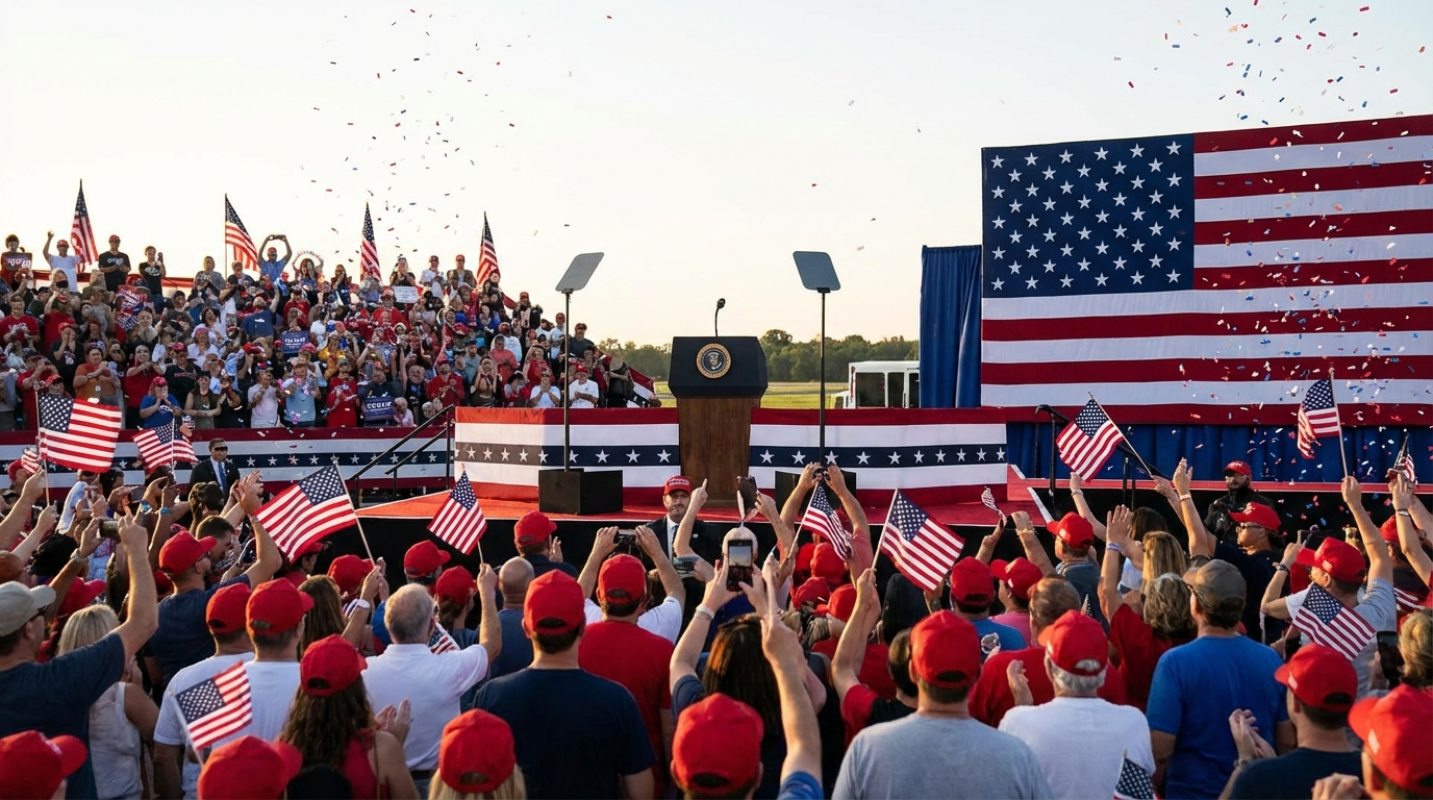
So what does this actually mean? It means the Democratic Party lost ground in important urban and suburban pockets, particularly among working-class voters who prioritized economic stability and traditional cultural values over progressive social issues. The enthusiasm gap also played a role; Trump’s rallies and direct appeals generated energy that translated into higher turnout among his newly expanded coalition.
The Electoral College Sweep
The combination of economic pain, cultural momentum, and demographic shifts culminated in a decisive Electoral College victory. It wasn’t a landslide, but a surgical sweep.
Donald Trump secured 312 electoral votes and won the national popular vote with a plurality of 49.8%⁴. He didn’t just win the election; he won the map.
The key to his second term was winning all seven of the important swing states: Arizona, Georgia, Michigan, Nevada, North Carolina, Pennsylvania, and Wisconsin⁴. These races were excruciatingly close, often decided by less than 3% of the vote. In Georgia, like, his margin was razor-thin, just +0.2%. In Pennsylvania, it was +1.2%⁹.
That’s the core of the victory. Not policy, but pain. He successfully captured the voters who felt forgotten, alienated, or financially squeezed, regardless of their ethnic background. He convinced just enough working-class voters in the suburbs and exurbs of the Rust Belt and Sun Belt that he was the only one willing to disrupt the political system that they felt was failing them.
The 2024 election wasn't a mandate for a specific policy platform; it was a powerful, successful protest vote against the status quo, delivered by an expanded coalition that finally found a home outside the traditional political parties. It proved that in modern American politics, cultural identity and economic anxiety are often far more potent than political experience.
Sources:
1. Bankrate Survey on the 2024 Election and the Economy
https://www.bankrate.com/personal-finance/2024-election-and-the-economy-survey/
2. CBS News Exit Polls and JHU Analysis on Inflation
https://hub.jhu.edu/2024/11/20/how-inflation-impacted-2024-election/
3. EY Analysis on the Economic Impact of US Elections
https://www.ey.com/en_us/insights/approach/the-economic-impact-of-the-us-elections-your-questions-answered
4. Wikipedia Summary of the 2024 United States Presidential Election
https://en.wikipedia.org/wiki/2024_United_States_presidential_election
5. Giving Compass Article on Analyzing the 2024 Election
https://givingcompass.org/article/analyzing-the-2024-election-shifting-voter-coalitions-and-strategic-campaign-decisions
6. Pew Research Center on Voting Patterns in the 2024 Election
https://www.pewresearch.org/politics/2025/06/26/voting-patterns-in-the-2024-election/
7. Expert Commentary on Trump's Media Approach (Referencing Joe Rogan)
https://www.youtube.com/watch?v=LBNd84h_XNQ
8. ResearchGate Linguistic Appraisal of Donald Trump's 2024 Rhetoric
https://www.researchgate.net/publication/395371849_Strategic_Dialogic_Positioning_in_Donald_Trump's_2024_Presidential_Re-election_Announcement_A_Linguistic_Appraisal_of_Engagement_Resources
9. Cook Political Report 2024 Demographic Swingometer Data
https://www.cookpolitical.com/swingometer/2024