 (Image source: Gemini)
 The promise of equal opportunity is a cornerstone of modern society. We’re taught that if you work hard, you can succeed. But what happens when the starting line is dramatically different for everyone? What happens when your zip code dictates your lifespan, and your parents' bank account predetermines the quality of your education?
This isn't a theoretical question; it's the reality shaped by economic inequality. We aren't just talking about income disparity—the difference between the lowest and highest salaries—but wealth disparity, which is far more corrosive. Wealth includes assets, property, and investments, and it’s distributed alarmingly unevenly. Across OECD countries, the top 10% of households own more than half—about 52%—of all household wealth.² This concentration of resources doesn't just buy bigger houses; it buys better health and superior education, creating a self-perpetuating cycle of advantage.
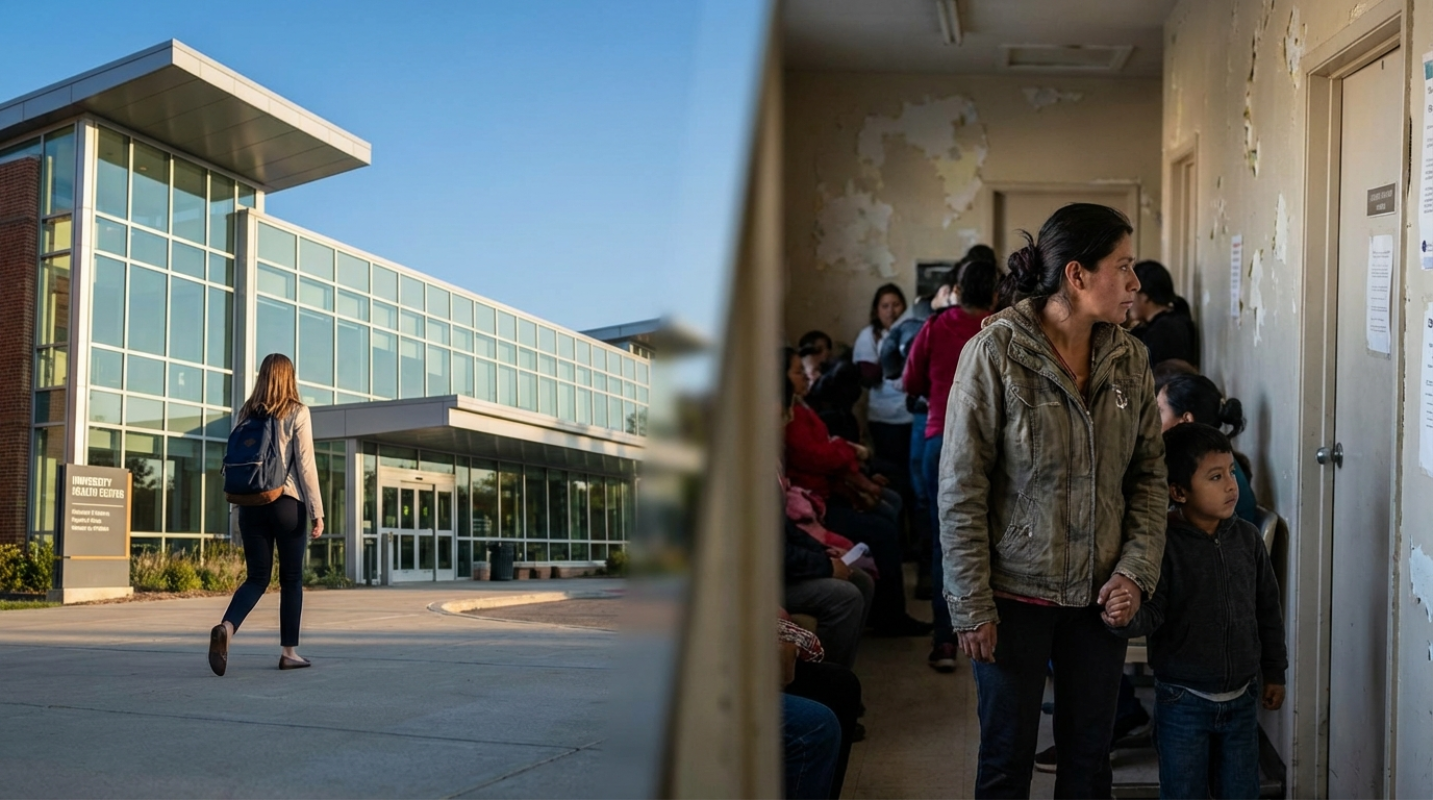
The undeniable truth is that deep economic gaps directly exacerbate disparities in educational attainment and health outcomes. If you are born poor, you are immediately fighting uphill battles on two of the most important fronts necessary for upward mobility: learning and longevity. It’s a systemic design flaw that demands immediate attention.
The Educational Divide
If you’ve ever watched a local school board meeting debate property taxes, you’ve witnessed the core mechanism driving educational inequality in many nations. Since K-12 public schools often rely heavily on localized property tax funding, wealthy neighborhoods inherently fund their schools better than struggling ones.
Think of it like this: A school in a high-value real estate district can afford smaller class sizes, state-of-the-art labs, and highly compensated teachers. Meanwhile, a school down the road, perhaps only a few miles away, is struggling to replace outdated textbooks. The result is a deep opportunity gap. Children from disadvantaged socio-economic backgrounds often lack access to important resources like advanced placement courses, strong extracurricular activities, and modern technology. It’s the digital equivalent of giving some students a Formula 1 car while others are stuck on a bicycle.
This disparity starts early. Early Childhood Education (ECE) is identified as one of the most cost-effective tools for building skills, especially for vulnerable children. Yet, access is unequal. Even in highly developed regions, investment varies wildly. Like, the United Kingdom spends significantly less per child on pre-primary education compared to the OECD average.⁵ These early funding failures limit lifelong learning potential before a child even reaches primary school.
The gap only widens when students reach the university level. The escalating cost of higher education and the resulting burden of student loan debt are crushing for low-income families. Recent OECD analysis shows a stark intergenerational divide: only 26% of young adults whose parents lacked upper secondary education achieve a tertiary qualification. In sharp contrast, that figure jumps to 70% for those whose parents are tertiary-educated.⁵ The deck is stacked, and the result is that inequality of opportunity accounts for up to 35% of all disparities in educational achievement. If you don't have the degree, your lifetime earning potential is severely capped.
Healthcare Access
Education provides the tools for success, but health provides the ability to use them. When economic inequality impacts healthcare, the consequences are immediate and often fatal.
The link between employment status, income, and the quality of health insurance is brutally clear in systems relying heavily on private coverage. Low-wage jobs often offer prohibitively expensive or extremely limited plans, forcing families to choose between paying rent and preventative care. This leads to what we call "medical deserts"—geographic areas, often rural or densely poor urban centers, where access to specialized doctors, modern facilities, and even basic primary care is scarce.
So what does this actually mean for your life? It means a significant difference in longevity. Across the EU, there is currently an eight-year gap between the countries with the highest and lowest life expectancies.⁶ Although national averages mask the scale of the problem, economic status is the primary driver of who lives longer and who dies sooner.
Globally, the situation is dire. The World Bank notes that fundamental inequities leave half of the global population without needed health services. Worse, 2 billion people face severe financial hardship because of healthcare costs.⁷ Think about that number. Two billion people are one serious illness away from economic ruin.
This isn't just about emergency room visits; it’s about daily quality of life. Socioeconomic status plays a massive role in preventative care and chronic disease management. Obesity rates, like, are over 60% higher among adolescents from low-affluence families compared to their high-affluence peers.⁶ Without proper nutrition, consistent preventative screenings, and affordable medication, manageable conditions become life-threatening crises, further draining the family’s limited resources.
How Poor Health Undermines Education and Earning Potential
The tragedy of this situation is that poor access to education and poor access to healthcare don't operate independently; they feed one another in a toxic, vicious cycle.
Start with the social determinants of health. If a child lives in unstable, overcrowded housing, lacks consistent, nutritious food, or is constantly stressed by financial precarity, their cognitive development suffers. It’s impossible to focus on geometry when you’re worried about where your next meal is coming from. Health problems, like asthma exacerbated by poor housing quality, lead to missed school days, which results in lower educational attainment.
Now, reverse the flow. A lack of education limits job opportunities, pushing individuals into low-wage, high-risk employment that offers no benefits. This lack of income means they cannot afford quality healthcare. When a major health crisis hits, the consequences are catastrophic. Medical debt forces educational dropouts or compels working adults to reduce their hours, further slashing their already meager earning potential.
This cycle is how poverty and health disparities become intergenerational. When parents are struggling with chronic illness or crushing debt, they have fewer resources—time, money, and emotional energy—to invest in their children’s education. Globally, the failure to provide a basic safety net exacerbates this problem; 3.8 billion people remain uncovered by adequate social protection benefits.¹ We are watching the intergenerational transmission of poverty happen in real-time.
Policy Pathways to Break the Barrier
Breaking this iron grip requires integrated policy solutions—not just patching holes, but rebuilding the foundation. We need to stop treating education and healthcare as commodities available only to the highest bidder and start recognizing them as fundamental human rights and needed public goods.
One important pathway is reforming how we fund public services. This means moving toward more progressive taxation to make sure the wealthy pay their fair share, providing the necessary revenue to equalize school funding regardless of local property values. Universal Pre-K and significantly subsidized higher education matter levers that can dramatically shrink the opportunity gap, especially for the most vulnerable.
On the healthcare front, the goal must be true universal coverage. The World Bank estimates that guaranteeing basic social security floors in low- and middle-income countries would require an additional $1.4 trillion annually. Although that sounds massive, it is only about 3.3% of their aggregate GDP.¹ The cost of inaction—measured in lost productivity, early mortality, and shattered lives—is far greater.
Community-based organizations also play a key role, often acting as the only lifeline in medical and educational deserts. They address immediate needs while advocating for systemic change.
Top Recommendations for Systemic Change
- Equalize Educational Funding: Implement state or national funding formulas that decouple K-12 school budgets from local property taxes.
- Expand Early Childhood Access: Invest heavily in high-quality, subsidized Early Childhood Education, proven to yield strong, lasting effects for vulnerable children.
- Make sure Universal Health Coverage: Prioritize policies that guarantee needed health services to all citizens, minimizing the risk of catastrophic medical debt.
- Address Social Determinants: Integrate health policy with housing, nutrition, and environmental policies to tackle the root causes of chronic illness and cognitive impairment.
The crisis of economic inequality isn't abstract; it manifests in the classroom and the clinic. It determines whether you get a fair shot at life or if you're permanently sidelined. We have the data, we know the solutions, and we understand the consequences of delay. The time for integrated policy action—treating health and education not as separate issues, but as two sides of the same coin—is now.
Sources:
1. World Bank Group: Global Monitoring Report on Financial Protection in Health 2024
https://documents1.worldbank.org/curated/en/099549506102441825/pdf/IDU-bd155bac-6d78-43af-8833-f87564a9d6c8.pdf
2. OECD: Society at a Glance 2024
https://www.oecd.org/en/publications/society-at-a-glance-2024_918d8db3-en/full-report/income-and-wealth-inequalities_7ac4178f.html
3. World Bank: Health Overview
https://www.worldbank.org/en/topic/health/overview
4. OECD: Health at a Glance Europe 2024
https://www.oecd.org/en/publications/health-at-a-glance-europe-2024_b3704e14-en.html
5. OECD: How's Life? 2024
https://www.oecd.org/en/publications/how-s-life-2024_90ba854a-en.html
6. OECD: Health at a Glance Europe 2024: Obesity and Education
https://www.scribd.com/document/798801288/OECD-Health-at-a-Glance-Europe-2024-State-of-Health-in-the-EU-Cycle
7. World Bank: Global High-Inequality Population
https://openknowledge.worldbank.org/server/api/core/bitstreams/f75dd18d-4e3f-44f9-b455-7f0d8e189609/content
This article is for informational and educational purposes only. Readers are encouraged to consult qualified professionals and verify details with official sources before making decisions. This content does not constitute professional advice.