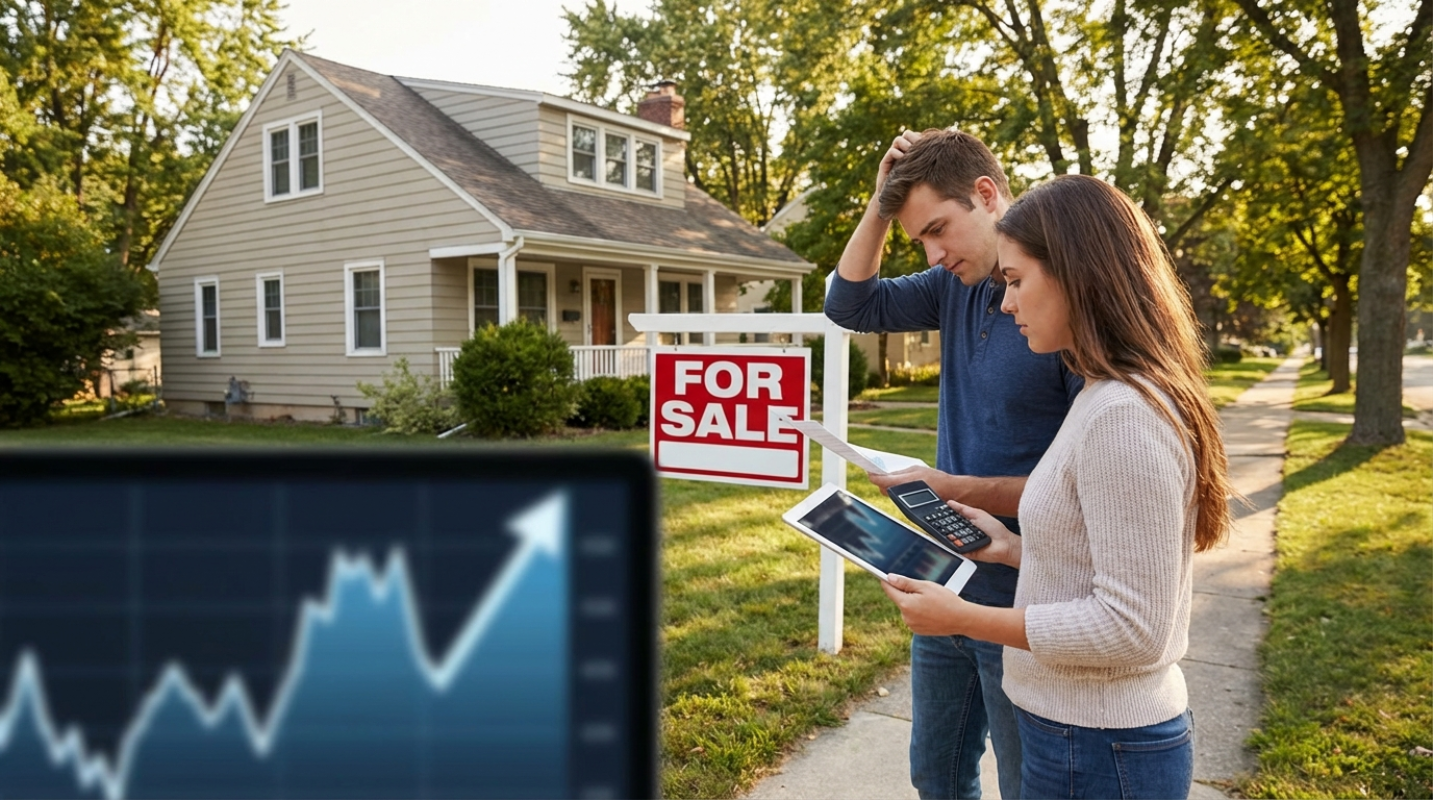
 (Image source: Gemini)
 Ready to buy your first home? Great. Now, look at the interest rates. For first-time homebuyers (FTHBs), the journey from saving a down payment to closing on a house is already a gauntlet of financial stress. But in the current economic climate, defined by the Federal Reserve’s aggressive attempts to curb inflation, the single biggest variable impacting your success isn’t the local school district or the granite countertops—it’s the cost of money itself.
The Fed doesn't directly set mortgage rates, but its actions—hiking or cutting the benchmark Federal Funds Rate—have a massive, immediate ripple effect through the financial markets. This influence, channeled primarily through the 10-year Treasury yield, dictates the cost of the 30-year fixed mortgage. For you, the prospective buyer, this means rate fluctuations don't just shift the market; they redefine your entire purchasing power and the fundamental timing of your entry.
Impact on Monthly Payments and Buying Power
When the Fed raises rates, it’s like turning up the gravity on your budget.
Historically, the 30-year fixed mortgage rate has moved in tandem with the Fed’s policy. Following the rate hikes that began in early 2022, the average 30-year rate breached 8% in October 2023.¹ This wasn't just a historical footnote; it was a financial catastrophe for affordability.
So what does this actually mean for your wallet?
Let’s quantify the impact. If you were looking at a typical home price in early 2024, a rate hovering around 6.5% might have resulted in a substantial monthly payment. But if that rate jumps to 7.5% or 8%, that payment explodes. In the third quarter of 2024, a first-time buyer putting down the median 9% could expect a monthly payment of roughly $3,240 for a typically priced home.
This massive increase leads to payment shock.
More importantly, higher rates drastically reduce your maximum affordable loan amount. Lenders use Debt-to-Income (DTI) ratios to determine how much house you can afford. If your monthly expenses stay the same but your mortgage payment increases by hundreds of dollars due to rates, the DTI ratio forces the lender to slash the principal amount they are willing to offer you. You might find your $400,000 budget suddenly shrinks to $350,000—or less—without having done anything wrong.
Opportunities and Hidden Dangers for New Buyers
The dream scenario, of course, is a significant rate cut. When rates drop, affordability instantly improves. Your monthly payment decreases, and your home search radius expands beyond the undesirable zip codes.
But waiting for the perfect moment is a high-stakes gamble.
In 2025, a whopping 75% of prospective buyers reported waiting for home prices and interest rates to fall before making a move. Sound familiar? This collective "wait-and-see" approach creates a hidden danger: when rates do finally drop, everyone rushes in at once.
This is the counter-effect of falling rates: increased competition.
If rates dip, say, from 7% to 6%, the market suddenly floods with buyers who were previously priced out. This massive surge in demand quickly leads to intense bidding wars, especially in high-demand areas. The resulting inflated home prices often eat up all the savings gained from the lower interest rate. You end up paying less interest over 30 years, perhaps, but you paid $20,000 more upfront for the house. It’s a vicious cycle where perfect timing is almost impossible to catch.
Indirect Effects on Inventory and Down Payments
The Fed’s policy affects more than just the mortgage calculator; it freezes the entire housing supply chain.
The most insidious indirect effect is the rate lock-in effect on existing homeowners. Millions of current owners locked in rates below 4%, or even 3%, during the pandemic boom. Why would they ever sell now and trade that 3% rate for a new 6.5% rate? They won’t. They stay put.
This reluctance to sell keeps housing inventory importantly low, which further sustains high home prices, even as buyer demand fluctuates.² This inventory shortage hits you, the first-time buyer, the hardest, forcing you to compete fiercely for the few homes that do hit the market.
This high-rate environment also fundamentally shifts the profile of the FTHB. The median age of a first-time homebuyer reached a record high of 38 in 2024, a direct reflection of the long delays required to save up enough money.³ Saving for a 9% median down payment—the highest median since 1997—is nearly impossible when you’re facing skyrocketing rental costs, which are also often inflated by the overall economic pressures.
Approaches for First-Time Buyers in a Volatile Rate Environment
The key to succeeding in this market isn't waiting for rates to hit 3% again; it’s about financial preparedness and strategic flexibility. Since mortgage rates are projected to remain in the mid-6% range for the foreseeable future, you need tools to manage that cost.
Using Lender Tools
- Rate Buydowns: Ask sellers or builders about a temporary buydown. This is where funds are used to pay down the interest rate for the first one or two years of the loan (e.g., 2-1 buydowns), giving you time for your income to grow or for rates to drop enough for a refinance.
- Pre-Approval and Rate Locks: Getting pre-approved is non-negotiable. Importantly, work with a lender who offers extended rate locks (60 or 90 days), especially if you are facing a slow closing process. This protects you if rates spike during your escrow period.
Creative Financing and Co-Buying
- Adjustable-Rate Mortgages (ARMs): Although riskier, ARMs offer lower initial payments for the first 5, 7, or 10 years. If you plan to sell or refinance before the fixed period ends, an ARM can be a powerful tool to afford a higher principal now.
- Co-Buying: Facing high costs? You are not alone. In 2025, 22% of Gen Z buyers purchased homes with siblings, showing the necessity of pooling resources to afford the down payment and meet DTI requirements.
Prioritizing Preparation Over Perfect Timing
The biggest mistake a first-time buyer can make is treating the current rate environment as a temporary obstacle that will soon vanish. The consensus among experts suggests that rates will stabilize in the mid-6% range. This means the high rates aren't a temporary blip; they are the new normal for the next few years.
Instead of obsessively watching the daily rate tickers, focus on what you can control: your credit score, your cash reserves, and your DTI ratio. If you can afford the monthly payment at a 6.5% rate, you should buy when you find the right house, not when you think the market has bottomed out.
Why? Because if rates do drop significantly, you can always refinance later and capture the savings. But if you wait, and rates drop, you’ll be forced into a bidding war against a suddenly enormous pool of motivated buyers, potentially paying a premium that far exceeds any interest rate savings.
The housing market is inherently challenging, but success belongs to the prepared, not the patient. Focus on securing the best possible personal financial profile, and let refinancing be your approach for future rate drops.
Sources:
1. Forbes Advisor Mortgage Interest Rates Forecast
https://www.forbes.com/advisor/mortgages/mortgage-interest-rates-forecast/
2. The 2025 Affordability Bowl: First-Time Buyers Face 4th and Long, But the Game Isn’t Over
https://blog.firstam.com/economics/the-2025-affordability-bowl-first-time-buyers-face-4th-and-long-but-the-game-isnt-over
3. First-Time Home Buyers Shrink to Historic Low of 24% as Buyer Age Hits Record High
https://www.nar.realtor/newsroom/first-time-home-buyers-shrink-to-historic-low-of-24-as-buyer-age-hits-record-high
This article is for informational and educational purposes only. Readers are encouraged to consult qualified professionals and verify details with official sources before making decisions. This content does not constitute professional advice.