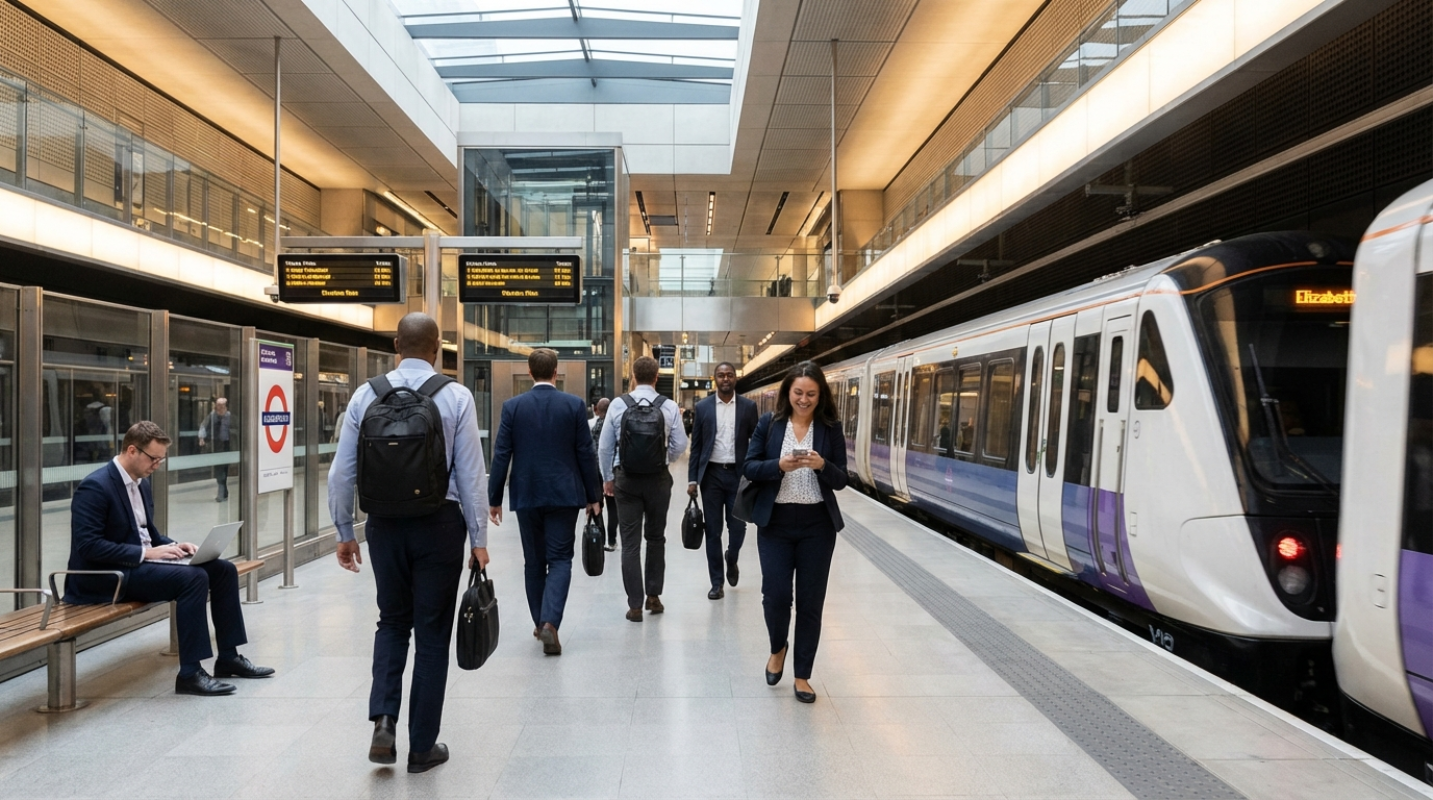
 (Image source: Gemini)
 If you’ve ever commuted in London, you know the feeling. That moment when the train groans to a halt between stations, the air gets thick, and the automated voice apologizes for "minor signal failure." For decades, the London Underground—a historical marvel needed to the city’s economic engine—has been fighting a losing battle against its own age. But things are finally shifting.
The daily commute, once defined by unpredictable delays and stifling heat, is being fundamentally reshaped by a wave of targeted infrastructure investment spanning 2024 and 2025. These aren't just cosmetic changes; we're talking about deep-level technical modernization that is measurably improving speed, boosting reliability, and, importantly, making the journey far more comfortable.
This transformation matters, especially now. With hybrid working patterns concentrating demand sharply on Tuesdays, Wednesdays, and Thursdays, the Tube needs to handle intense peak pressure better than ever before. If you rely on the Underground to get to work, here is exactly how these upgrades are changing your daily reality.
Speed and Capacity: The Impact of Digital Signaling and New Rolling Stock
The biggest headache for any commuter is wasted time. The frustration of watching a five-minute journey stretch into ten because the train ahead is crawling. This is where modern signaling technology steps in, acting as the digital equivalent of a massive traffic control overhaul.
The core of this change is the Four Lines Modernisation (4LM) program. This massive project replaces 1970s signaling infrastructure on the District, Circle, Hammersmith & City, and Metropolitan lines with Communications-Based Train Control (CBTC).
So what does this actually mean for your journey?
CBTC allows trains to communicate constantly with the trackside equipment, calculating the safest minimum distance between each service. This precision means trains can run closer together, more often. On the central sections of these lines, the system is designed to enable the operation of up to 32 trains per hour—a frequency increase that dramatically boosts overall capacity.¹
The result? Quicker commutes, even during the peak. Data from recently completed phases shows that workers traveling on the eastern end of the District line are already seeing journey times reduced by up to three minutes when heading toward central hubs like Embankment. That might sound small, but saving 30 minutes a week on travel adds up fast.
The Piccadilly Line Revolution
Beyond signaling, new rolling stock is important. Think about the iconic, yet aging, deep-level lines. The Piccadilly line, a backbone for many workers commuting from North London and Heathrow, is getting a complete overhaul.
The first of the new trains, set to enter passenger service throughout 2025, are designed specifically for the modern commuter. They feature walk-through carriages, eliminating the bottlenecks at doors and improving passenger distribution. Importantly, they introduce air conditioning and USB charging ports—a game-changer for anyone who has endured a deep Tube journey in July.²
These new trains aren't just about comfort; they are built for reliability, reducing the maintenance time and unexpected breakdowns that cause those classic mid-tunnel delays.
Improved Passenger Experience: Accessibility, Air-Conditioning, and Connectivity
A successful commute isn't just about speed; it's about dignity and comfort. For too long, the Underground’s historical design meant that for many workers, particularly those with mobility issues, the network was simply inaccessible.
TfL’s "Equity in Motion" plan, launched recently, directly addresses this. The goal is ambitious: to increase the proportion of step-free Tube stations to half of the network. This isn't charity; it's economic necessity. A 2024 survey highlighted that accessibility barriers are directly impacting the workforce, finding that half of disabled professionals had actually declined job offers due to concerns about their ability to commute.³
The focus on accessibility extends beyond major station rebuilds. Simple, effective solutions like the introduction of mini ramps (bridging devices) at stations with small platform gaps are immediately improving the practicality of step-free journeys for thousands of workers.
Beating the Heat and Staying Connected
For workers on the Central and Victoria lines, the summer months have historically meant arriving at the office already stressed and sweating. Although air conditioning is still a massive challenge on the oldest deep-level lines, the introduction of new, more efficient ventilation systems and better-sealed rolling stock (like the overhauled Central line trains) is incrementally improving conditions.
Perhaps the most immediately noticeable change for productivity, but is 4G and 5G connectivity.
You can now use your phone, stream music, and send emails across much of the deep Tube network, including major sections of the Northern, Jubilee, and Central lines. For the modern hybrid worker, this turns dead time into productive time. You can clear your inbox, join a quick call, or finalize documents before you even step into the office. It’s a key tool that shrinks the effective length of the working day by allowing you to work during the journey.
Reliability and Resilience: Building a Future-Proof Commuting Network
The biggest upgrade you don't notice is the one that prevents disaster. Reliability is the bedrock of worker trust. If you know your train will arrive when promised, your entire morning stress level drops.
The modernization efforts are focusing heavily on infrastructure resilience—the hidden systems that keep the trains running. This includes power supply upgrades and tunnel refurbishment, particularly on the deep-level lines that are prone to heat-related failures. By investing heavily in planned, scheduled maintenance—often during weekend closures—TfL is drastically reducing the likelihood of unexpected, system-wide disruptions during the important weekday peaks.
Commuter trust is a key indicator of success. Recent surveys show customer satisfaction with platform crowding has seen a significant bump. Why? Because the increased frequency provided by the new signaling means that even if demand is high, the wait time is shorter, and the concentration of people on the platform is less intense.
This combination of improved signaling and resilient infrastructure means that the Tube is becoming a dependable tool, rather than a frustrating variable, in the working day.
Optimizing Your Journey: Tools and Future Outlook
The upgrades currently underway are not just about fixing old problems; they are about preparing London for future growth. The system is changing to meet the needs of the 2026 workforce, which demands flexibility, speed, and comfort.
We’ve seen the enormous positive impact of major projects like the Elizabeth Line, which has created new commuter catchment areas and radically reduced east-west journey times. Similarly, the long-awaited completion of the Bank Station upgrade will relieve a major interchange bottleneck, speeding up transitions for thousands of Northern and Central line commuters every day.
The overarching goal of these investments is clear: to make sure London remains competitive. A city where workers can quickly and reliably access their workplaces is a healthy economic center. The improved capacity, air quality, and digital connectivity are all designed to make the daily grind less of a grind and more of an opportunity.
Top Recommendations for the Modern Commuter
To truly benefit from the upgraded network, workers should adapt their routines and technology usage.
- Check Service Status Digitally: Always use the TfL Go app or similar tools. The reliability improvements mean you can trust the projected arrival times more than ever.
- Embrace Off-Peak Travel: Although peak demand is concentrated, consider shifting your start time by 30 minutes to take advantage of the marginal dip in crowding and benefit fully from the increased frequency of upgraded lines.
- Use Connectivity Time: Use the new 4G/5G coverage to handle needed work tasks while underground. This get the most froms your personal time once you arrive at your destination.
The London Underground is no longer just a museum piece that moves people; it is rapidly transforming into a high-tech, high-capacity transport system fit for the 21st-century worker. The next few years will cement its role not just as a means of transport, but as an integral, reliable part of the working week.
Sources:
1. Four Lines Modernisation
https://tfl.gov.uk/travel-information/improvements-and-projects/four-lines-modernisation
2. TfL to deliver a full programme of improvements for 2024-25 as set out in its draft business plan
https://tfl.gov.uk/info-for/media/press-releases/2023/december/tfl-to-deliver-a-full-programme-of-improvements-for-2024-25-as-set-out-in-its-draft-business-plan
3. BBK Manifesto 2025: End the UK's Public Transport Accessibility Gap
https://www.boltburdonkemp.co.uk/our-insights/posts/bbk-manifesto-2025-end-the-uks-public-transport-accessibility-gap/