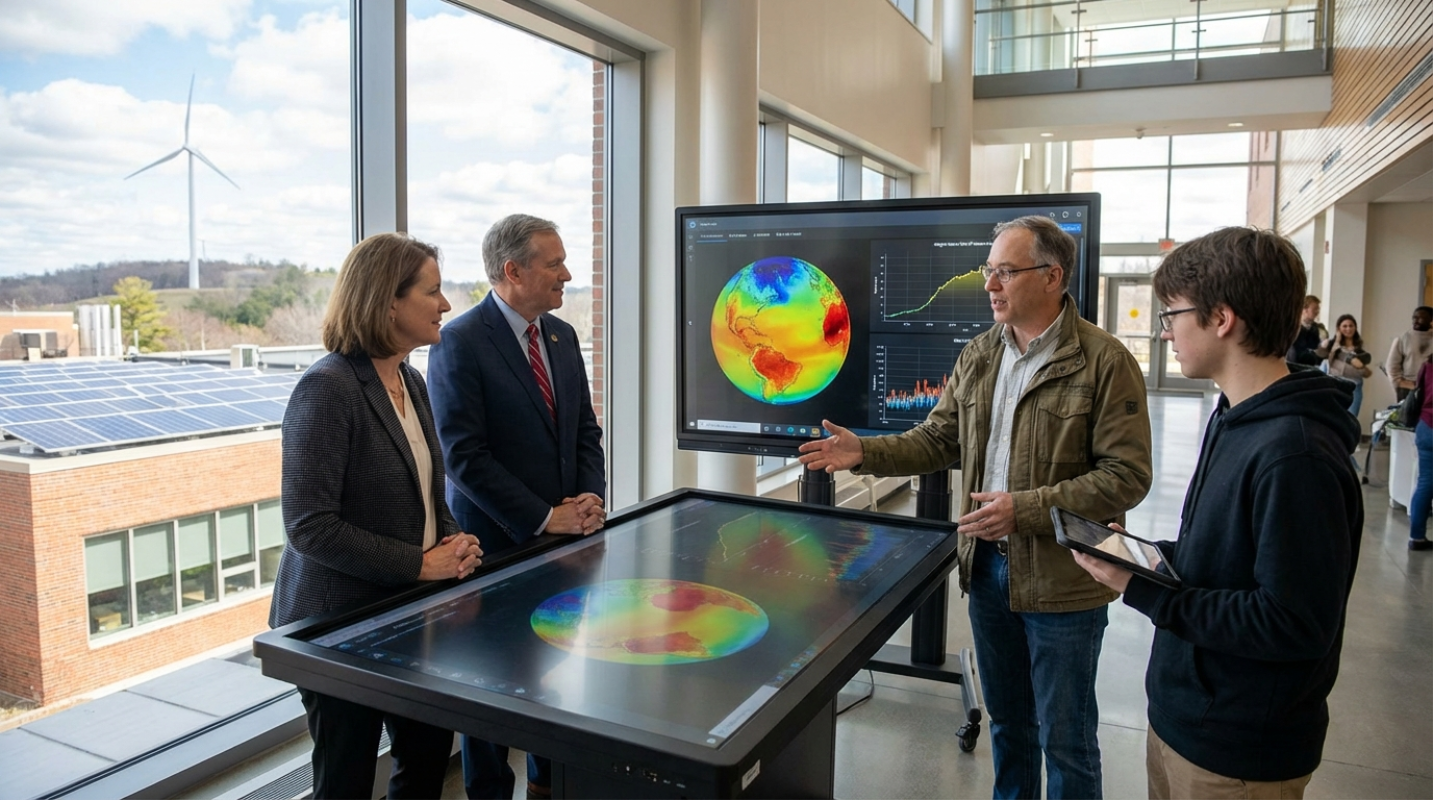
The climate clock isn't just ticking anymore; it’s ringing the alarm. If you’ve felt a sense of urgency creeping into your daily news feed, you’re not imagining things. The pace of climate discovery has accelerated dramatically, moving far beyond abstract warnings about the future. New scientific developments aren't just confirming old theories; they are providing definitive, real-time evidence of a rapidly changing planet.
This surge of data—from precise extreme event attribution to terrifying updates on Earth’s tipping points—is forcing policy shifts and fundamentally altering how the public perceives environmental risk. We are witnessing a scientific certainty that makes hedging politically untenable, demanding immediate, evidence-based action.
Precision in Attribution: Linking Extreme Weather to Climate Change
For decades, climate skeptics could hide behind the phrase, "You can't link one storm to climate change." That loophole has slammed shut.
Thanks to advanced attribution science, initiatives like the World Weather Attribution can now analyze a major weather event—say, a devastating heatwave or an extreme flood—and determine the human fingerprint within days. This isn't guesswork; it’s statistical reality.
Think of it like forensic science for the atmosphere. In 2024, deadly heatwaves across South and South-East Asia were found to be up to 30 times more likely due to human-induced climate change. Likewise, the extreme rainfall that caused catastrophic floods in the Mediterranean was up to 50 times more likely and significantly more intense.¹
So what does this actually mean for policy?
Definitive attribution strengthens legal cases against polluters and, more importantly, justifies immediate, massive funding for adaptation and mitigation. When a regional government knows, with 95% certainty, that climate change multiplied the cost and intensity of a recent disaster, it changes the conversation from "if" to "how much, how fast." The science provides the necessary political cover and financial justification for spending billions on infrastructure upgrades.
Revisiting Tipping Points: New Models and Urgent Policy Implications
Perhaps the most anxiety-inducing development is the shift in scientific consensus regarding planetary tipping points. These are thresholds where a small amount of additional warming can trigger large, irreversible changes in the Earth system.
For years, these points—like the potential slowdown of the Atlantic Meridional Overturning Circulation (AMOC) or the dieback of the Amazon rainforest—felt like theoretical risks for the distant future. Not anymore. New research suggests the world has already reached its first major tipping point: the irreversible decline of warm-water coral reefs. At current heating levels, 99% of coral reefs experience heatwaves too frequent for recovery.²
Experts warn the planet is "on the brink" of several others, forcing governments to adjust long-term targets. The fact that human-induced warming reached 1.55°C above pre-industrial levels in 2024—making it the warmest year on record—means the viability of the 1.5°C pathway must be urgently reassessed. If current policies imply a high risk of tipping important Earth system elements, then those policies are fundamentally inadequate. The science is demanding a complete overhaul of global ambition.
Technological Advancements in Monitoring and Feedback Loops
It’s not just the models that are getting better; the monitoring is too. New satellite technology and AI are now being used to track emissions with unprecedented accuracy.
We can now pinpoint methane leaks—a potent greenhouse gas—with high precision. This improved data is the digital equivalent of shining a spotlight on corporate transparency. When regulators and the public can see, in near real-time, where emissions are coming from, it drastically increases the pressure for accountability and regulatory enforcement. This shift—from relying on corporate self-reporting to independent, scientific verification—is a game-changer for enforcing climate policy.
Translating Scientific Certainty into Decisive Action
The scientific certainty surrounding climate change has never been higher, and this is visibly eroding climate skepticism in policymaking circles.
The data is driving tangible changes, particularly in the energy sector. In 2024, renewables accounted for over 92% of total power expansion globally, a major shift driven by falling costs and strong public support.³ This progress is substantial, lowering projected warming from the catastrophic levels of a decade ago.
We are also seeing important policy action at the sub-national level. States across the U.S., like Maine, which set a goal of 100% clean electricity by 2040, are translating scientific risk into legislative mandates.⁴
Top Recommendations for Policy Implementation
- Prioritize Adaptation Funding: Use definitive attribution data to justify immediate investment in climate-proofing infrastructure, especially in coastal and flood-prone areas.
- Reassess 1.5°C Targets: Update national climate plans (NDCs) based on the latest tipping point science, moving beyond temporary overshoot approaches.
- Mandate Real-Time Monitoring: Require industries to adopt and fund third-party monitoring technologies for GHG emissions to make sure transparency and rapid leak detection.
But the public perception shift isn't always linear. Although most people accept the reality of warming, translating that acceptance into support for specific, costly policies remains complex. Like, public favorability for increasing the fuel efficiency of automobiles dropped from 72% in 2020 to 62% in 2024, suggesting that political pushback against certain mitigation measures still finds fertile ground.⁵
Sources:
1. When Risks Become Reality: Extreme Weather in 2024
https://www.worldweatherattribution.org/when-risks-become-reality-extreme-weather-in-2024/
2. Debriefed: Earth's First Tipping Point
https://www.carbonbrief.org/debriefed-earths-first-tipping-point-climate-adviser-interview-how-warming-affects-childrens-health/
3. Summary of Recent Climate Science Developments and Policy Shifts (2024 Data)
(Based on WMO/Copernicus data provided in the research query)
4. Policy Shifts and Public Perception (US Sub-national Policy Examples)
(Based on US State Plan data provided in the research query)
5. Public Favorability for Increasing Fuel Efficiency (2024 Data)
(Based on Public Perception Shift data provided in the research query)