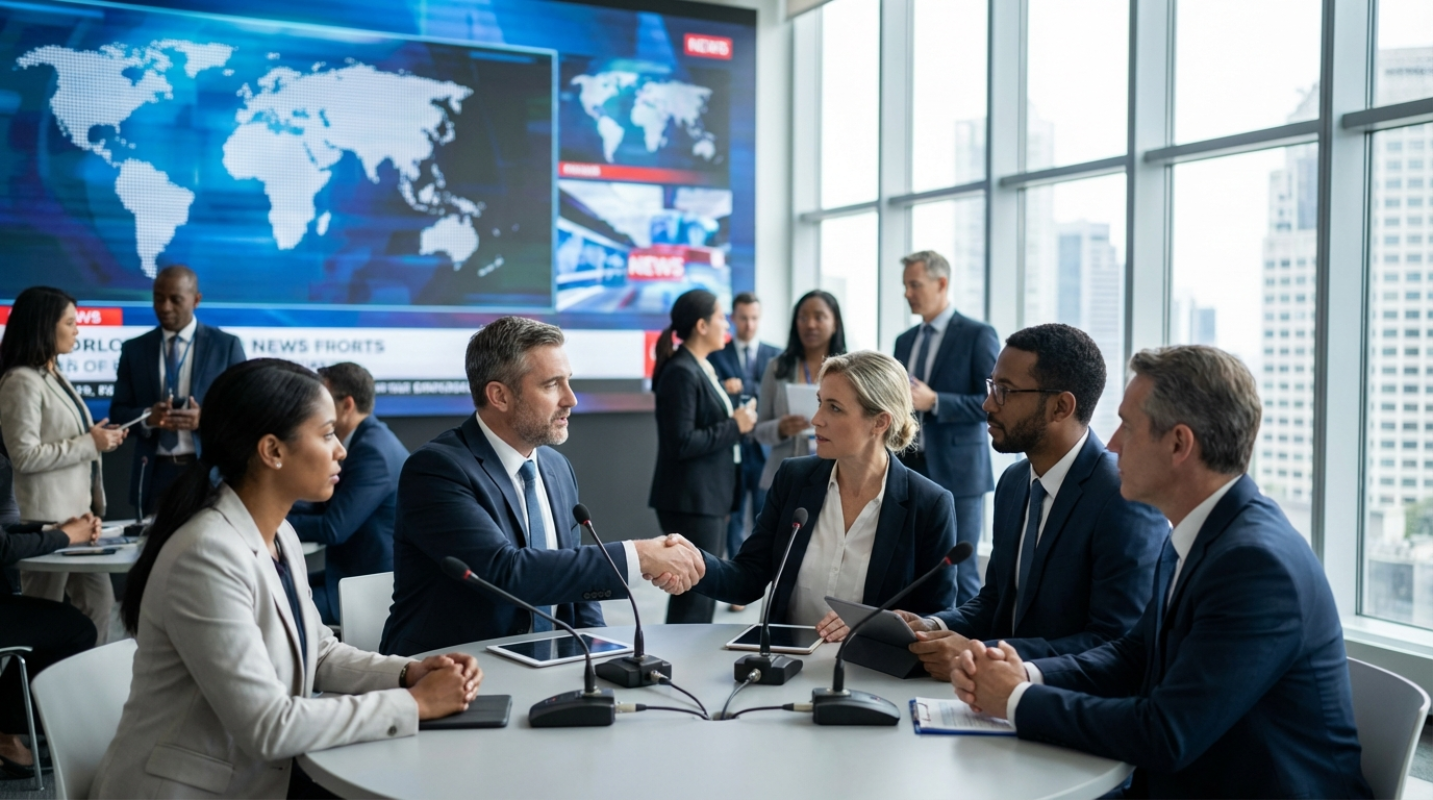
If you think global politics moves slowly, you haven't been paying attention to your news feed. Today, an unexpected presidential primary result, a new tariff proposal, or a sudden military maneuver in a distant sea can send immediate, tangible ripple effects across international markets and diplomatic channels. We are living in an era where geopolitical shifts aren’t measured in quarterly reports; they’re tracked hourly.
This isn’t just about headline drama. This daily flow of global political updates—from sanctions announcements to technology breakthroughs—reshapes international relationships, often forcing governments and multinational corporations to pivot their approaches overnight. A significant deterioration characterizes the geopolitical environment in global peacefulness, a trend that’s been worsening for over a decade.¹
So what does this actually mean for you, whether you’re a policymaker, an investor, or just someone trying to understand why your supply chain is suddenly strained? We need to look beyond the big treaties and focus on the daily friction points: the great power rivalry, the internationalization of conflict, and the weaponization of economics.
Great Power Competition — US, China, and the Shifting Balance of Influence
The defining feature of global relations remains the intense, daily competition between Washington and Beijing. This isn't just a contest for military might; it’s a battle over who writes the rules for the 21st-century economy.
If you’re running a business with exposure to Asia, you’re constantly understanding the tension between these two giants. Experts have noted the growing risk of military confrontation, but the fight is playing out most intensely in the economic sphere. China, in particular, is prioritizing the "securitization of everything," often choosing ideological consistency over pure economic pragmatism. When Beijing makes a policy shift—say, restricting data flow or tightening control over important minerals—it creates immediate uncertainty for every partner nation. Nearly half of China experts have expected US-China relations to deteriorate further, reflecting a persistent, low-grade diplomatic fever that dominates the daily news cycle.²
The flashpoints are constant. The Taiwan Strait, like, remains the ultimate pressure cooker. Every statement from Taipei, every naval exercise by the PLA, and every high-level US congressional visit generates immediate diplomatic fallout. These actions, whether intended for domestic consumption or international signaling, force allies to constantly reassess their alignment and risk exposure. Consistency in foreign policy is a luxury few major powers can afford these days, and that volatility makes international relationships fragile.
Regional Hotspots — Conflict, Mediation, and Diplomatic Fallout
The current reality is that diplomatic efforts to end fighting are failing worldwide. Conflicts aren't just local tragedies anymore; they are increasingly becoming internationalized, making solutions exponentially harder to achieve. Today, 78 countries are engaged in a conflict beyond their borders, driven largely by geopolitical fragmentation and major power competition.³
Consider the ongoing war in Ukraine or the constant volatility in the Middle East. The Israel-Hamas war, which began in late 2023, remains a leading concern. The primary daily risk isn't just the fighting itself, but the constant threat of escalation into a wider regional conflict involving neighboring states and potentially Iran. Foreign policy experts judge this escalation to be a high-likelihood, high-impact scenario, meaning that every day brings new risks for global energy security and shipping lanes.⁵
When a local skirmish flares up, the immediate consequences are felt globally. Refugee flows surge, impacting the politics of neighboring countries and Europe. Global energy prices spike, hitting your pocketbook instantly. And multilateral organizations, like the UN Security Council, often find themselves paralyzed, their daily mediation efforts rendered ineffective by the veto power wielded by major powers protecting their own interests. The instability in the Sahel, where military juntas are forging new alliances with groups like the Wagner Group, further illustrates how global strategic players immediately fill local political vacuums.
Economic Statecreate — Sanctions, Supply Chains, and Digital Currencies
The most dramatic daily influence on international relationships comes through the tools of economic statecreate. Forget tanks and troops; the new weapons are tariffs, investment controls, and sanctions.
The sheer volume of restrictive trade practices has exploded, indicating a policy-driven reversal of global integration. This isn’t an accident; it’s a deliberate approach known as "de-risking" or "friend-shoring," where political reliability is prioritized over cost efficiency. Supply chains are being reshaped daily based on political risk, forcing companies to move production and seek out politically aligned partners.²
Perhaps the most consequential daily dynamic is the backlash against the overuse of sanctions, particularly by the United States. This has inadvertently accelerated a transition toward multipolarity. Countries are wary of being too dependent on the US Dollar (USD) when that dependence can be weaponized overnight. This fear is fueling a drive toward de-dollarization, leading nations like Russia to deepen trade with countries like China and Turkey and use alternative payment systems, such as the China Interbank Payment System (CIPS).¹⁰
This is the digital equivalent of building a new global financial architecture. It's a slow, steady process, but every trade deal signed outside the USD framework is a small step toward fracturing the established financial order.
The Rise of Middle Powers and Non-Alignment Trends
The fragmentation of the global order has created a important opportunity for middle powers—countries like India, Brazil, and Turkey—to assert greater autonomy. They’re tired of being forced to choose between Washington and Beijing.
Instead, they are pursuing a pragmatic approach of "mixing and matching" allegiances. They'll buy cheap oil from Russia, sign technology deals with the US, and accept massive infrastructure investment from China's Belt and Road Initiative (BRI). This trend is powerfully visible in the expansion of blocs like BRICS, which offers an alternative to the established Western alliances.
This shift complicates traditional diplomacy immensely. You can no longer assume that a country will vote or trade a certain way based on its historical alliance. Why? Because many developing nations are heavily indebted—spending an average of 42% of government revenue on servicing debt—and China, as the largest creditor, holds significant daily influence over their policy decisions.¹⁰
Sources:
1. Global Peace Index 2025
https://www.visionofhumanity.org/wp-content/uploads/2025/06/Global-Peace-Index-2025-web.pdf
2. Bracing for Geopolitical Competition: Insights from the MERICS China Forecast 2024
https://merics.org/en/comment/bracing-geopolitical-competition-insights-merics-china-forecast-2024
3. 10 Conflicts to Watch in 2024
https://www.crisisgroup.org/cmt/global/10-conflicts-watch-2024
4. 2024 Geostrategic Outlook
https://www.ey.com/en_it/insights/geoapproach/2024-geostrategic-outlook
5. Conflicts to Watch 2024
https://www.cfr.org/reports/conflicts-watch-2024
6. 2024 Economic Statecreate Summit Report
https://potomacinstitute.org/media/attachments/2024/11/05/2024-economic-statecreate-summit-report.pdf