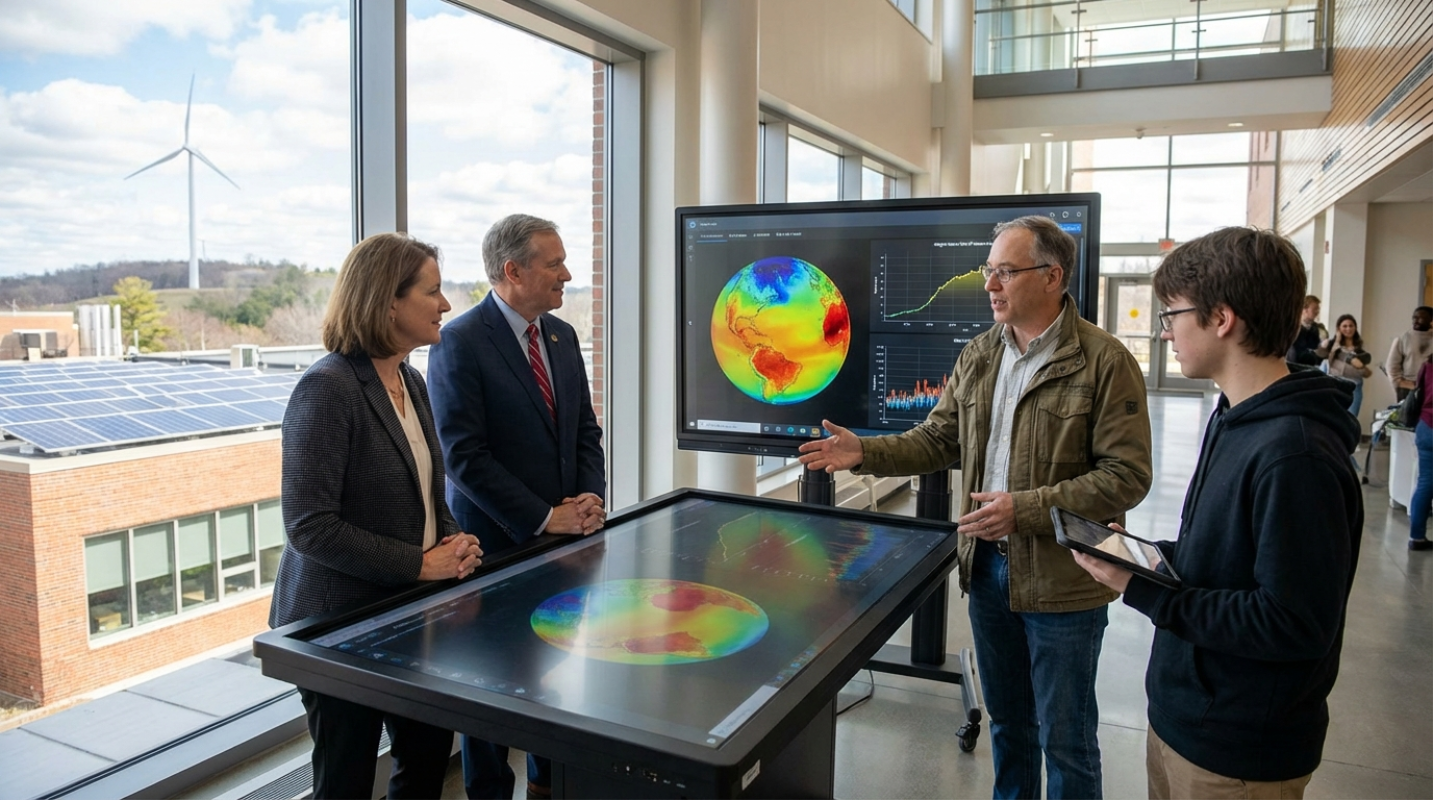
Science isn't just happening; it’s accelerating. If you felt like breakthroughs dominated the news cycle in health, space, and technology in 2025, you weren’t wrong. We’re not talking about incremental changes here; we’re talking about fundamental discoveries that are already rewriting textbooks, changing how doctors treat disease, and redefining our place in the cosmos.
This isn't just academic chatter. This is the breaking news that forms the foundation of your future. We’re diving into the landmark discoveries from global labs—in biotech, AI, deep space, and sustainable energy—that are impacting policy and progress around the world right now.
Breakthroughs in Gene Editing and Therapeutics
For years, we heard about gene editing as a theoretical marvel. Well, in 2024, the theory became reality.
The UK authorized CASGEVY™, the first CRISPR/Cas9 gene-edited therapy, specifically targeting debilitating conditions like sickle cell disease.¹ This isn't just a clinical win; it’s the moment personalized medicine transitioned from a promise to a prescription. Think of it: doctors are now fixing genetic errors at the source.
Equally impressive is the fight against infectious disease. The injectable medication Lenacapavir offers up to six months of protection against HIV with just one shot, showing a near-perfect success rate in clinical trials.² That’s a game-changer for global public health efforts, drastically simplifying prevention in high-prevalence areas.
Meanwhile, the drugs originally designed for diabetes, like Semaglutide, are revealing therapeutic potential far beyond weight loss. Studies suggest beneficial effects on heart disease, kidney disorders, and even sleep apnea.³ Your doctor’s toolkit is about to get a serious, multi-purpose upgrade, offering hope for metabolic conditions that were previously untreatable.
Next-Generation Artificial Intelligence and Computing
AI isn't just writing essays anymore; it's fundamentally driving discovery.
The 2024 Nobel Prize in Chemistry went to the developers of AlphaFold, recognizing AI's power to accurately predict protein structures. Think about that: AI is now designing new proteins that nature never created.⁴ This ability to rapidly infer complex structures has the potential to accelerate drug design and trace how diseases develop in real-time.
On the general AI side, OpenAI’s GPT-4o (released in May 2024) set a new standard, seamlessly blending text, audio, and vision processing. It’s the digital equivalent of a polymath, capable of handling complex information simultaneously.
More practically, AI is saving us from disaster. Google DeepMind’s GraphCast model showed higher accuracy and faster processing than conventional forecasting methods, correctly predicting Hurricane Lee’s impact three days ahead of traditional models.³ AI is moving from novelty to needed infrastructure, providing insights that could potentially mitigate 5–10% of global greenhouse gas emissions by 2030.
New Insights from Astrophysics and Planetary Science
Look up. The universe got a lot more interesting last year, thanks to both robotic explorers and powerful telescopes.
China’s space program achieved a historic feat in June 2024 with the Chang'e 6 mission, successfully returning rock samples from the far side of the Moon—a first for any nation. Initial analysis suggests the Moon was volcanically active much longer than previously thought.⁹
Closer to home (relatively), astronomers discovered Gaia BH3 in May: a stellar-mass black hole weighing a staggering 33 times the mass of our Sun. That’s the heaviest one known in the Milky Way, located 1,926 light-years away.¹⁰ It’s the kind of discovery that truly makes you feel small.
And speaking of big launches, NASA sent the Europa Clipper probe soaring toward Jupiter in October 2024, aiming to determine if that icy moon can actually harbor life beneath its frozen crust. The exploration is ramping up, and the data gathered by these missions is challenging old astronomical theories at breakneck speed.
Environmental Science and Novel Energy Solutions
Climate science delivered a sobering reality check. For the first time, the global average temperature topped 1.5 degrees Celsius above pre-industrial levels in 2024.⁸ The urgency is palpable, and the need for new energy solutions has never been greater.
Ironically, the very technology we rely on for scientific advancement—AI—is creating an industrial-scale challenge for power supply. The ballooning electricity demands of AI data centers for firms like Microsoft and Google are forcing them to turn to advanced nuclear energy, including Small Modular Reactors (SMRs), just to keep the lights on and the servers cool. This AI-energy nexus is fundamentally reshaping how we view power generation and infrastructure planning.
But there’s hope in storage and efficiency. Research is pushing beyond scarce battery materials. New investments in lithium iron phosphate (LFP) batteries are expanding, projected to take 45% of the EV market by 2029. Plus, innovative solutions like elastocaloric heat pumps are emerging to drastically cut the energy needed for heating and cooling without harmful refrigerants.⁸ It’s the transition from lab discovery to scalable application that matters most now.
Sources:
1. Scientific Breakthroughs 2024: Emerging Trends to Watch
https://www.cas.org/resources/cas-insights/scientific-breakthroughs-2024-emerging-trends-watch
2. NIH Research Highlights Human Health Advances
https://www.nih.gov/news-events/nih-research-matters/2024-nih-research-highlights-human-health-advances
3. Top Scientific News and Breakthroughs of 2024
https://knowablemagazine.org/content/article/society/2024/top-scientific-news-and-breakthroughs-of-2024
4. The 7 Most New AI Breakthroughs of 2024 That Are Reshaping Our Future
https://www.brainforge.ai/blog/the-7-most-new-ai-breakthroughs-of-2024-that-are-reshaping-our-future
5. Top Energy Stories 2024
https://www.weforum.org/stories/2024/12/top-energy-stories-2024/