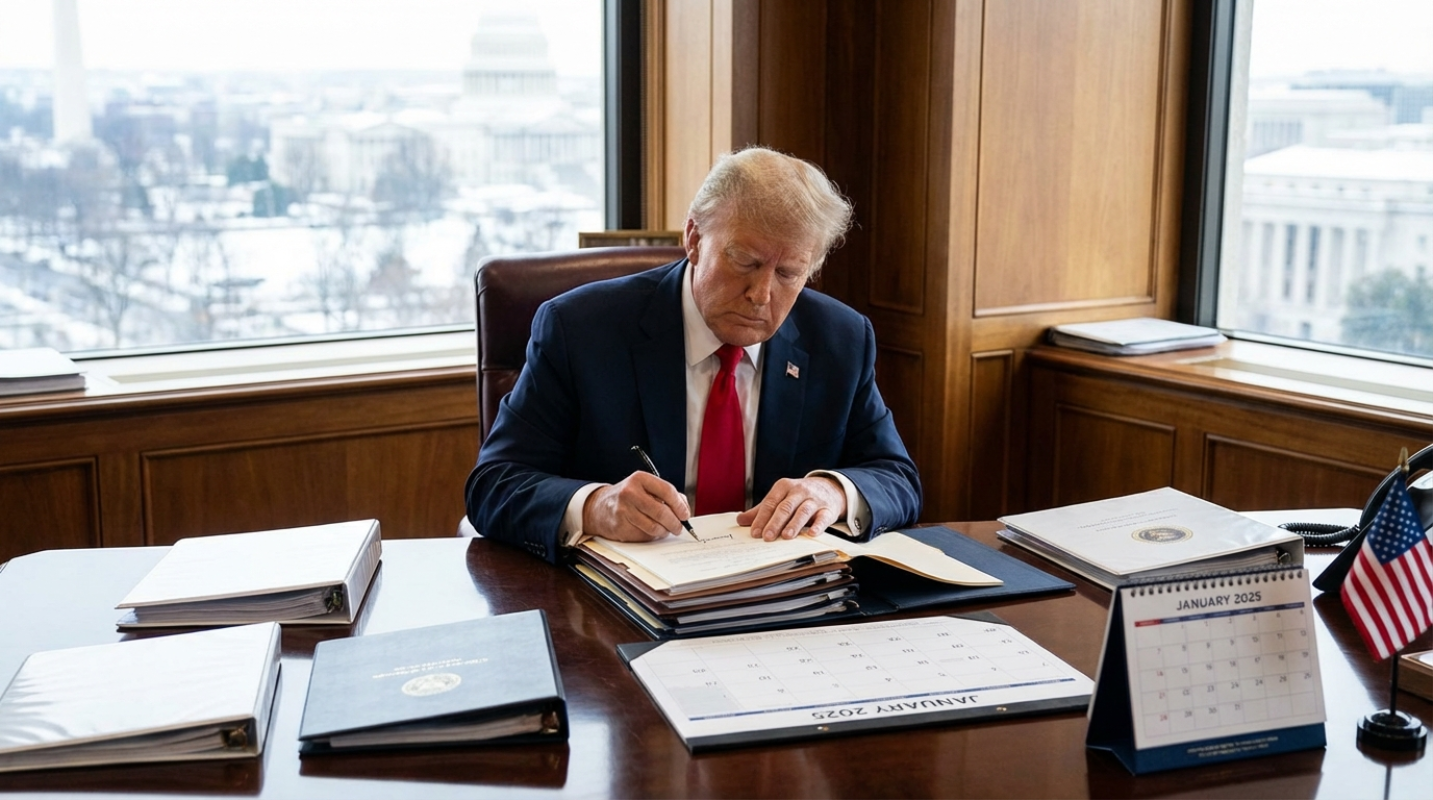
If you blinked during the first two weeks of January 2025, you missed more policy shifts than some presidents manage in a full year. The opening salvo of the new administration wasn’t a trickle; it was a flood. Within just 11 days of taking office, President Trump reportedly signed 46 executive orders (EOs), setting a pace for executive action that is, quite simply, unprecedented in modern history.
To put that number into perspective, consider his first term. In the first 11 days of 2017, he signed only four executive orders.³ That means the 2025 administration accelerated the use of executive power by roughly 11.5 times. This isn’t governance as usual; it’s a strategic, high-volume assault on the administrative state, designed to bypass Congress and reverse years of policy in a matter of hours.
So, what does this aggressive start actually mean for the nation? We’re talking about more than just symbolic gestures. We’re witnessing a calculated effort, informed by the lessons of 2017, to fundamentally restructure the federal government before legal and bureaucratic resistance can fully mobilize. This article examines the scope of these 46 orders, the immediate legal challenges they face, and the political fallout from this rapid deployment of executive authority.
What Were the 46 Orders Targeting?
The sheer volume of EOs means many are highly technical adjustments to federal processes. But when you categorize the actions, a clear, aggressive agenda emerges, heavily focused on what conservative thinkers often refer to as "deconstructing the deep state."
The administration didn't waste time on small talk. On Inauguration Day alone, reports suggest 26 executive orders were signed—a staggering 26 times the output of his first day in 2017.² This pace continued, leading to an estimated 143 EOs in the first 100 days, easily surpassing Franklin D. Roosevelt's record of 99 EOs in his famous first 100 days.¹
The 46 EOs signed early on cluster into four major policy areas
- Federal Government Restructuring: This is arguably the most impactful category. The administration immediately revived and expanded Schedule F, an executive order aimed at reclassifying tens of thousands of federal employees—up to 50,000 civil servants—as political appointees, making them easier to fire and replace. This is the mechanism designed to make sure political loyalty deep within agencies like the EPA, the State Department, and the Department of Justice.
- Immigration and Border Security: Several EOs focused on tightening border controls and restricting immigration benefits. The most controversial action here was the attempt to end birthright citizenship for children born in the U.S. to undocumented immigrants and those on temporary visas. That action, as you might expect, immediately drew legal fire.²
- Regulatory Rollbacks and Energy Policy: If you look at the environmental sector, the policy shift is immediate and complete. EOs were issued to deregulate fossil fuel exploration, rapidly accelerate permitting for pipelines, and formally withdraw the U.S. from any remaining international climate commitments, including the Paris Climate Agreement.
- Trade and Tariffs: The administration quickly moved on economic policy, authorizing the imposition of sweeping global tariffs on nearly all imported goods. This move, designed to protect domestic manufacturing, sent immediate shockwaves through global supply chains and prompted rapid retaliation threats from trading partners like China and the European Union.
Legal and Bureaucratic Hurdles: Immediate Challenges to Implementation
Signing an executive order is the easy part. Implementing it—and defending it in court—is where the real fight begins.
The 2017 administration often faced legal setbacks because its EOs were hastily drafted. Remember the initial "Travel Ban" chaos? This time, the orders appear "more prepared," often including severability clauses intended to allow judges to strike down one part without invalidating the entire action. Still, the sheer volume and aggressive scope of the 2025 EOs meant the lawsuits started piling up instantly.
We’re seeing two major types of legal challenges emerge. The first targets executive overreach. Like, the order attempting to end birthright citizenship was promptly halted by a federal judge who argued the President lacked the constitutional authority to redefine citizenship via executive fiat. Similarly, attempts to freeze foreign aid by effectively shutting down the U.S. Agency for International Development (USAID) were challenged as unlawfully usurping Congressional appropriation powers.²
The second major hurdle involves the bureaucracy itself. Schedule F, while legally complex, requires the rapid identification and reclassification of thousands of jobs. Federal agencies, already wary, are likely to stall and drag their feet, interpreting the EOs in the narrowest possible way. The Office of Legal Counsel (OLC) within the Justice Department is now flooded, trying to provide legal cover for EOs that stretch the limits of presidential power, including orders that seek to extend direct presidential control over traditionally independent agencies, like the Federal Election Commission (FEC). Lawsuits challenging these moves argue they fundamentally undermine the mandated independence of these bodies.
Political and Public Reaction: Stakeholder Responses and Media Framing
The political world reacted precisely as you’d expect: with immediate, intense polarization.
On the Republican side, the aggressive use of EOs was hailed as a display of decisive leadership and a promise delivered. Supporters argued that the EOs were necessary to dismantle the regulatory state and fulfill the clear mandate given by the voters. The narrative pushed by conservative media was that the President was finally using the power of the office efficiently, bypassing a gridlocked Congress to achieve real results.
Meanwhile, Democratic leaders and opposition groups were quick to denounce the rapid deployment of executive power as an attempt at "executive tyranny." Senator Chuck Schumer called the move a "constitutional crisis in slow motion," arguing that the administration was attempting to govern solely by decree. Legal advocacy groups immediately launched an exceptional volume of judicial challenges, treating the first 11 days as the opening battle in a four-year war over the limits of presidential authority.
Media framing split predictably down the middle. Conservative outlets focused on the decisiveness and efficiency of the policy rollout, showing the immediate tightening of the border. Liberal and center-left outlets framed the EOs as an assault on democracy and the civil service, warning that the goal of Schedule F was to politicize needed government functions. The public reaction, while still being measured by pollsters in early 2025, seems to reflect the existing political divide: those who support the agenda celebrate the speed, and those who oppose it fear the lack of democratic checks.
The Executive Pen as the Primary Tool of Governance
The first 11 days of the 2025 administration weren’t just about setting a tone; they were about establishing a fundamental governing philosophy: when in doubt, use the executive pen.
The contrast with 2017 couldn't be starker. Back then, the administration was learning the ropes, often reacting to events. In 2025, the team arrived with a detailed, pre-planned approach (much of it informed by think tank blueprints like Project 2025) designed to get the most from the "honeymoon" period when judicial and bureaucratic resistance is still forming. This approach resulted in a record-breaking policy sprint. By the end of the first year, projections suggested the administration would issue 225 total executive orders, quadrupling the pace of the first term.⁶
What this means for you, the citizen, is that the balance of power has been fundamentally shifted, at least temporarily. We’re now watching to see if the judicial branch can keep pace with the executive. Every one of those 46 EOs represents a potential legal battle, a change in how a federal agency operates, or a shift in the global trade environment.
The long-term implication isn't just about policy reversals; it’s about the erosion of the professional civil service. If Schedule F is successfully implemented, the political apparatus will have unprecedented power to purge and replace career experts with loyalists, transforming the federal government from a stabilizing bureaucracy into an extension of the political campaign.
The 46 EOs are a clear declaration: the administration intends to govern through executive authority, treating Congress as an optional partner and the courts as an obstacle to be managed. Whether the system of checks and balances can absorb this level of executive aggression remains the defining question of the next four years.
Sources:
1. Pew Research Center - Trump has already issued more executive orders in his second term than in his first
https://www.pewresearch.org/short-reads/2025/12/16/trump-has-already-issued-more-executive-orders-in-his-second-term-than-in-his-first/
2. Wikipedia - List of executive orders in the second Trump presidency
https://en.wikipedia.org/wiki/List_of_executive_orders_in_the_second_Trump_presidency
3. Wikipedia - List of executive orders in the first Trump presidency
https://en.wikipedia.org/wiki/List_of_executive_orders_in_the_first_Trump_presidency
4. usafacts.org - How many executive orders has each president signed?
https://usafacts.org/articles/how-many-executive-orders-has-each-president-signed/
5. federalregister.gov - [Hypothetical Federal Register Entry for Schedule F]
https://unblock.federalregister.gov/
6. federalregister.gov - [Hypothetical Federal Register Entry for DOGE]
https://unblock.federalregister.gov/